
Can an Animal Communicator Help a Sick Cat?
Updated for 2026: This article was originally published years ago, but I’ve rewritten and expanded it to better reflect the kind of gentle, practical support Cat Mamas now offers to people caring for sick cats or grieving a cat they love.
Animal communicators tend to divide people very quickly.
Some people believe they have a real and beautiful gift.
Some people think the whole thing sounds impossible.
Some people are curious, but cautious.
And some people only start wondering about animal communication when an animal they love is sick, and the usual answers don’t feel like enough.
That was me.
Before my cat Moofy got sick, I was skeptical.
I probably would’ve put animal communication in the same mental basket as fortune telling, wishful thinking, and people who tell you your aura needs fluffing.
Then Moofy got cat cancer.
And when your cat is sick — really sick — your world changes.
You’re no longer having a calm theoretical debate about what’s possible.
You’re watching your beloved cat struggle.
You’re trying to understand what they need.
You’re asking the vet a million questions.
You’re researching late at night.
You’re looking for anything that might help you care for them better.
That doesn’t mean you’ve stopped being sensible.
It means you love your cat.
In my case, animal communication became one of the unexpected tools that helped me through Moofy’s illness.
Not instead of veterinary care.
Not as a miracle cure.
Not as a replacement for tests, treatment, pain relief, or proper medical advice.
But as another way to listen.
Another way to ask questions.
Another way to feel connected to the cat I was trying so hard to help.
The short answer
An animal communicator for cats should never replace a vet, especially when your cat is sick. They can’t diagnose disease, prescribe treatment, read scans, or safely tell you to stop medication. But some cat parents find animal communication helpful as a complementary form of support. A good animal communicator may help you reflect on your cat’s comfort, preferences, emotions, and daily experience, while encouraging you to keep veterinary care at the center.
What does an animal communicator do?
An animal communicator is someone who connects with an animal intuitively or telepathically and passes messages between the animal and their person.
Depending on the communicator, a session might involve:
- asking your cat questions
- sharing impressions about how your cat feels
- exploring emotional or behavioral issues
- asking about preferences, comfort, food, routines, or relationships
- helping the human understand what the animal may be experiencing, and
- offering reassurance during illness, grief, or end-of-life care.
Some animal communicators work from a photo.
Some speak with you by phone or video.
Some ask for background information first, while others prefer very little information so they can see what comes through.
That all sounds a little strange if you’ve never encountered it before.
I understand that completely.
But cat people already know that communication with cats is not limited to words.
You know your cat’s different meows.
You know when their tail says “don’t touch me.”
You know when they’re asking for food, company, space, or attention.
You know the look they give you when you’re late with dinner.
You know when they’re not quite themselves, even before anything obvious has changed.
So for me, animal communication didn’t feel like replacing logic.
It felt like taking seriously something I already knew: cats have preferences, emotions, opinions, and a very real inner life.
Animal communication is not veterinary medicine
This part matters.
If your cat is sick, your vet should be your first point of call.
Animal communicators are not a substitute for veterinary care.
They cannot diagnose cancer, kidney disease, thyroid disease, diabetes, infection, pain, or any other medical condition.
They cannot run blood tests.
They cannot interpret X-rays or scans.
They cannot prescribe medication.
They should not tell you to stop treatment.
A responsible animal communicator will never say:
“Don’t listen to your vet.”
“Your cat doesn’t need medication.”
“This will cure cancer.”
“You don’t need tests.”
“Your cat told me the vet is wrong.”
Any of these would be a serious red flag.
The way I see it, animal communication belongs in a different category.
It’s not medical diagnosis.
It’s not treatment.
It’s not proof.
It’s a complementary support tool.
It may help you think more deeply about your cat’s comfort, emotional state, daily routines, likes, dislikes, and quality of life.
It may help you ask better questions.
It may help you notice things you hadn’t quite put into words.
But the medical care still belongs with the vet.
Why I considered an animal communicator for my sick cat
When Moofy was diagnosed with cat cancer, I did what most devoted cat parents do.
First I panicked.
Then I started looking for answers everywhere.
I asked questions.
I researched.
I explored conventional and non-conventional options.
I wanted to understand what was happening to her, what might help, and whether there was anything I was missing.
If you’re in that frightening early stage yourself, I’ve written more about how to cope when your cat is diagnosed with cancer, including the shock, uncertainty and practical questions that can come with the diagnosis.
When your cat has a serious illness, especially something as frightening as cancer, you can feel incredibly helpless.
You want your cat to be able to tell you:
Does this hurt?
Are you scared?
Do you want this food?
Are you tired?
Is this treatment helping?
Do you still want to fight?
Are you ready to rest?
Of course, cats do tell us things – every single day.
They tell us through behavior, appetite, posture, hiding, purring, grooming, sleeping places, eye contact, and tiny changes in routine.
But during serious illness, it’s so easy to doubt yourself.
You wonder whether you’re seeing what’s really there, or what you desperately want to see.
That constant second-guessing is exhausting.
If you’re finding it hard to think about anything except your cat’s illness, When Your Cat Is Sick and You Can’t Stop Worrying may help you feel a little less alone in it.
Animal communication gave me another way to explore those questions.
Not in a dramatic, spooky, crystal-ball way.
More like sitting down with someone who was willing to focus deeply on Moofy and help me think about her experience.
That mattered to me.
What an animal communicator helped me with
My experience with animal communicators was not about being told magical secrets or being promised a cure.
It was more practical than that.
It helped me in three main ways.
1. It helped me think about Moofy’s comfort
When a cat is sick, comfort becomes everything.
Not just whether they’re alive.
Not just whether they’re eating a little.
Not just whether they can still walk from one room to another.
But whether they feel safe.
Whether their body is coping.
Whether their daily life still contains pleasure.
Whether they’re still able to be themselves.
An animal communicator helped me slow down and think about Moofy’s comfort in a more focused way.
What seemed to soothe her?
What seemed to tire her?
Was she choosing company or solitude?
Did she seem to want touch, or did she need more space?
Were there routines that still brought her peace?
These were not things that replaced veterinary advice.
They were things that helped me observe her more carefully at home.
That kind of attention can be very useful when your cat is ill.
Because the vet sees your cat in the clinic.
But you see your cat in real life.
You see the way they move through the house.
You see how they sleep.
You see what they avoid.
You see whether they still enjoy their favorite places.
You see the tiny daily changes that won’t be obvious during a ten-minute appointment.
Animal communication helped me trust that my observations mattered.
2. It helped me ask better questions
One of the hardest parts of caring for a seriously ill cat is knowing what to ask.
You can come home from the vet and suddenly realize your mind has gone blank.
You forgot to ask about pain.
You forgot to ask what signs would mean the illness is progressing.
You forgot to ask whether a change in behavior matters.
You forgot to ask what comfort care might look like.
A good animal communication session can sometimes bring up areas you may want to discuss with your vet.
For example:
Is my cat comfortable?
Could this behavior suggest nausea, pain, fatigue, or anxiety?
Is there a different way to make medication easier?
Would environmental changes help?
Should we talk about pain relief?
Should we talk about quality of life?
Should I ask whether we’re still treating, or whether we’re shifting toward comfort?
The communicator is not answering those medical questions.
But the session may help you identify the questions you need to take back to your vet.
That distinction is important.
Animal communication shouldn’t close down medical thinking.
It should open up better conversations.
3. It helped me feel more connected to Moofy
This was the biggest part for me.
Serious illness can make you feel separated from your cat, even while you’re physically with them all the time.
And in my case, acting like a helicopter mom.
You’re giving medication.
You’re watching symptoms.
You’re worrying about food.
You’re counting good days and bad days.
You’re trying to make decisions no one ever wants to make.
Sometimes the illness becomes so loud that it almost gets between you and the cat you love.
Animal communication helped me come back to Moofy herself.
Not just Moofy’s cancer.
Not just Moofy’s treatment.
Not just Moofy’s prognosis.
Moofy.
Her personality.
Her preferences.
Her bond with me.
Her way of moving through the world.
Her many opinions.
Her dignity.
Her presence.
That was valuable.
Not because it solved everything.
But because it strengthened our connection even further.
Why this can matter during cat illness
When your cat is sick, everyone tends to focus on the medical facts.
And of course, medical facts matter.
Diagnosis matters. Pain relief matters. Treatment options matter. Test results matter.
Appetite matters. Hydration matters. Weight matters. Mobility matters.
But illness is not only medical.
There’s also the emotional reality of the cat.
And the emotional reality of the person who loves them.
You may be trying to understand whether your cat is still enjoying life.
You may be wondering whether they feel frightened.
You may be trying to make their final weeks or months feel peaceful.
You may be looking for ways to support them without overwhelming them.
This is where I think animal communication can have value.
Not as proof.
Not as a replacement for evidence.
But as a way of paying attention.
A way of asking: What is this like for my cat?
That question is worth asking.
How to choose an animal communicator carefully
Because this field is personal, emotional, and largely based on trust, you do need to be careful.
A good animal communicator should feel respectful, calm, and grounded.
They should not pressure you.
They should not frighten you.
They should not make huge medical claims.
They should not encourage you to ignore your vet.
Look for someone who:
- understands that veterinary care comes first
- is clear about what they can and can’t do
- doesn’t claim to diagnose or cure disease
- respects your cat’s medical treatment
- speaks gently and responsibly
- leaves you feeling calmer, not panicked
- encourages practical observation
- is honest about their process and fees, and
- doesn’t pressure you into repeated bookings.
You don’t need someone who makes everything more dramatic.
You need someone who approaches your cat with care.
Questions you could ask in a session
If you decide to speak with an animal communicator while your cat is sick, it helps to prepare gentle, practical questions.
You might ask:
What brings my cat the most comfort right now?
Is there anything in their routine they like or dislike?
Are they feeling overwhelmed by anything?
Do they prefer company, quiet, touch, or space?
Is there anything I’m doing that helps them feel safe?
Is there anything I should pay closer attention to?
How can I support them better at home?
Do they seem tired?
What do they still enjoy?
What would help them feel loved and peaceful?
I would avoid using an animal communicator as the only source for yes-or-no medical decisions.
For example, I wouldn’t ask the communicator whether to stop treatment, whether to euthanize, or whether a symptom matters.
Those questions need veterinary input, careful observation, and your own grounded judgment.
But as part of a wider support system, animal communication may help you reflect.
What to do with the information afterward
After a session, don’t rush into big decisions.
Sit with it.
Write down what felt meaningful.
Notice what matched what you already know about your cat.
Notice what surprised you.
Notice whether anything practical came up that you can discuss with your vet.
For example, if the session makes you wonder whether your cat is uncomfortable, don’t treat that as a diagnosis.
Treat it as a reason to ask your vet more about pain relief, nausea, mobility, or palliative care.
If the session makes you think your cat wants more quiet, try offering a calmer resting place.
If the session makes you realize your cat seems overwhelmed by being handled, think about how to make medication, meals, and care gentler.
If the session makes you feel more connected, let that be enough.
Not everything has to become a treatment plan.
Sometimes comfort is the gift.
What animal communication can’t give you
Animal communication can be meaningful, but it has limits.
It can’t guarantee your cat will recover.
It can’t tell you with certainty how long your cat has.
It can’t prove whether a treatment is working.
It can’t replace bloodwork, imaging, examination, or medical monitoring.
It can’t remove the pain of serious illness.
And it can’t take the responsibility of decision-making completely away from you.
That last one is hard.
When you love a sick cat, you may want someone else to tell you exactly what to do.
You may want certainty.
You may want your cat to somehow speak in a clear sentence and say, “This is what I need.”
But most of the time, caring for a sick cat means gathering many kinds of information:
- what the vet says
- what the tests show
- what your cat’s behavior tells you
- what your heart knows
- what your cat’s daily comfort looks like
- what your cat still enjoys
- what your cat is losing, and
- what feels loving, not just hopeful.
Animal communication may be one part of that picture.
It shouldn’t be the whole picture.
Why I’m glad I tried it
I’m glad I spoke to animal communicators during Moofy’s illness.
Not because they saved her.
Not because they replaced the vet.
Not because they gave me a neat, certain answer.
They didn’t.
But they helped me feel less alone in trying to understand her.
They helped me think about her experience more deeply.
They helped me focus on her comfort, not just her disease.
They helped me remember that my relationship with Moofy was still alive and real, even while her body was struggling.
One of the unexpected things I learned during that time was that illness can change your relationship with a cat without making it any less precious.
I’ve written more about that in Caring for a Sick Cat: How Illness Can Deepen Your Bond.
And when you’re caring for a seriously ill cat, that can matter more than other people understand.
Sometimes we don’t just need more information.
We need a way to keep loving our cat through the uncertainty.
For me, animal communication helped with that.
You don’t have to believe everything to receive something helpful
I don’t think everyone needs to believe the same thing about animal communication.
You can be a believer.
You can be skeptical.
You can be somewhere in the middle.
Or you can decide it’s not for you at all.
But if your cat is sick and you’re drawn to the idea of speaking with an animal communicator, I don’t think you need to feel silly or ashamed.
Just stay grounded.
Keep your vet involved.
Don’t hand over your judgment to anyone.
Be careful with anyone who promises too much.
And remember that the deepest communication with your cat may still be the quietest kind.
The way they look at you.
The way they lean into your hand.
The way they choose to rest near you.
The way you know, without anyone telling you, that something has changed.
You’ve been listening to your cat for years.
An animal communicator may help you listen in a different way.
But the bond was already there.
Final thoughts
Animal communication isn’t a cure for a sick cat.
It’s not veterinary medicine.
It’s not something I would ever use instead of a vet.
But I do believe it can have a place, especially for cat parents who are trying to understand their sick cat more deeply, support them more gently, and feel connected during a frightening time.
For me, it wasn’t about chasing magic.
It was about love.
It was about asking, “What does my cat need from me now?”
And when your cat is sick, that’s such an important question.
Frequently Asked Questions
Can an animal communicator diagnose my cat’s illness?
No. An animal communicator should not diagnose illness.
If your cat is sick, they need veterinary care.
Animal communication may help you reflect on your cat’s comfort or behavior, but diagnosis and treatment should come from a qualified vet.
Can an animal communicator help if my cat has cancer?
Some cat parents find animal communication emotionally helpful when their cat has cancer, especially when they’re trying to understand comfort, quality of life, and daily preferences. But an animal communicator cannot treat or cure cancer, and they should never replace your vet or oncologist.
Is it safe to use an animal communicator for a sick cat?
It can be safe if you treat it as complementary emotional support, not medical care.
Be cautious of anyone who tells you to stop medication, ignore your vet, delay treatment, or buy expensive products that promise a cure.
What should I ask an animal communicator about my sick cat?
Good questions are usually gentle and practical.
You might ask what brings your cat comfort, whether they seem overwhelmed, what routines they enjoy, or how you can help them feel safe. Medical questions should still go to your vet.
Can an animal communicator tell me when it’s time to euthanize my cat?
I wouldn’t rely on an animal communicator alone for that decision.
End-of-life decisions need veterinary guidance, careful quality-of-life observation, and your own knowledge of your cat.
If this is the decision you’re facing, How Do You Know When It’s Time to Euthanise a Cat? walks through it in much more detail.
How do I know if an animal communicator is trustworthy?
Look for someone calm, respectful, transparent, and clear about their limits.
A trustworthy communicator should not claim to diagnose or cure disease, pressure you, frighten you, or tell you to ignore your vet.
Do I have to believe in animal communication for it to help?
Not necessarily. Some people approach it with full belief.
Others see it as a reflective, intuitive, emotionally supportive conversation.
You can stay open without handing over your judgment.
What if my family thinks animal communication is silly?
You don’t have to convince everyone.
If it helps you feel more connected to your sick cat, and it doesn’t replace veterinary care or lead you into unsafe choices, it can simply be one private form of support.
Further Reading
If you’re caring for a sick cat, these guides may also help you through some of the practical and emotional parts of what you’re facing.
How to Cope When Your Cat Is Diagnosed With Cancer
A cancer diagnosis can leave you frightened, overwhelmed and unsure what to do next.
This guide looks at those first difficult days and how to begin finding your footing again.
When Your Cat Is Sick and You Can’t Stop Worrying
When you love a sick cat, it can feel almost impossible to switch your mind off.
This article is for the days when you’re watching, checking and worrying about every little change.
Caring for a Sick Cat: How Illness Can Deepen Your Bond
Illness brings fear and uncertainty, but it can also create an extraordinary closeness between you and your cat.
This piece explores that quieter side of caring for a cat you love.

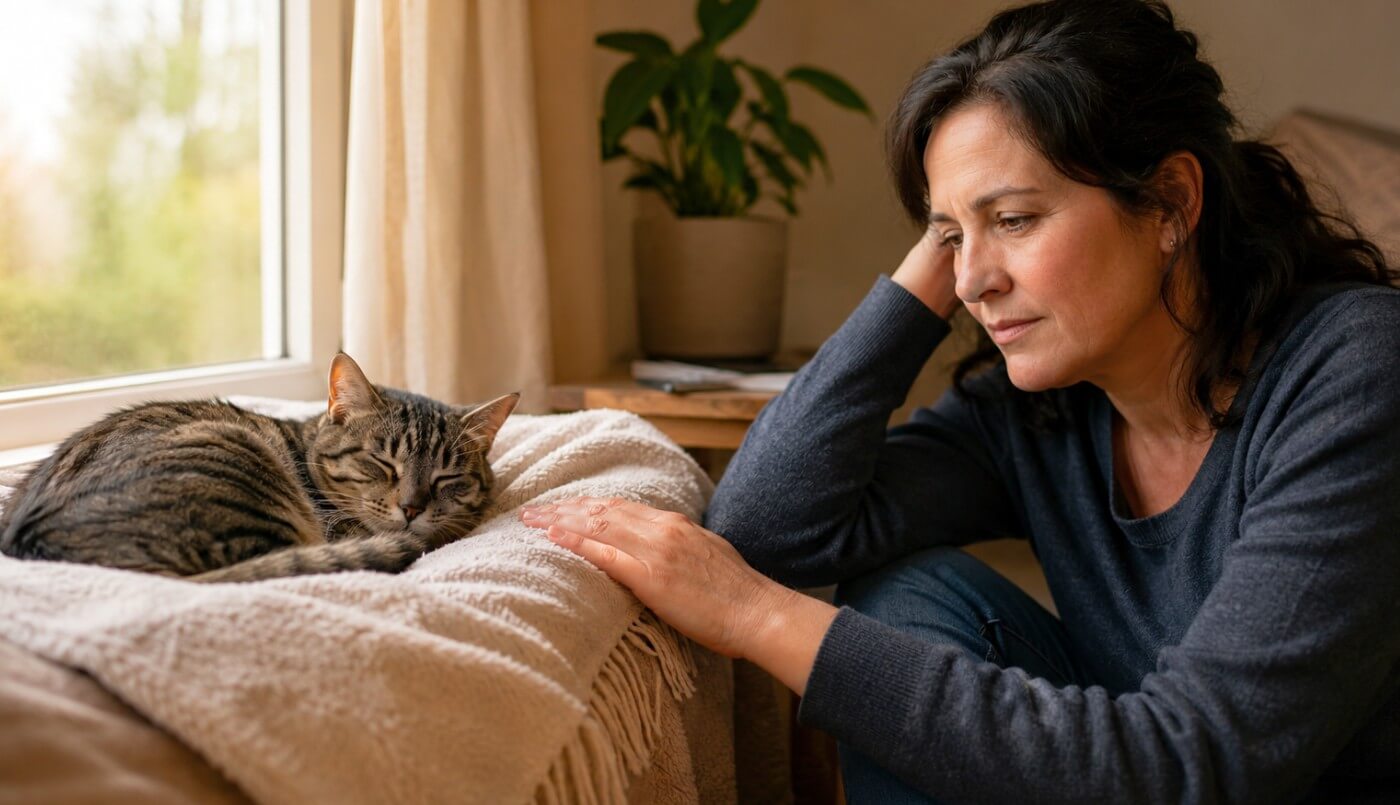
I know animal communication can be a sensitive topic, and people come to it from very different places.
For me, it was never about replacing the vet or looking for a miracle cure. It was one extra way of trying to understand Moofy more deeply while she was sick — her comfort, her needs, and the bond we still had during such a difficult time.
If you’ve ever tried animal communication with a sick cat, or even wondered about it, I’d love to hear your experience. Have you ever tried animal communication, or wished you could better understand what your cat was feeling?
As an Animal Communicator, I KNOW it is a real. It is easier to talk to someone else’s cats though, because they talk about stuff I know nothing about. My cats will be mysterious with me at times, though I have to say Samson is straight forward and the most amazing cat BECAUSE we communicate together. He is my child!
More cat people believe in Animal Communication, I think because there are “Cat Trainers” who just want to tell the animal what to do & control them. I have gotten cats to do amazing things like not kill birds, use the litter box, share how they feel helath wise- all telepathically. It is wonderful and worth seeking out.
Thanks for your comments here, Ann Marie! I’m a big fan of animal communication myself, and have learned a lot about my cat from it. That’s really interesting that it’s more challenging to communicate with your own cats! I guess because you know them so well and you already communicate in a million ways all the time. I appreciate your thoughts! 🙂