

When Your Cat’s Illness Can’t Be Cured: What You Can Still Do
Updated for 2026: This article was originally published several years ago and has been carefully revised to offer more helpful support for cat parents today.
Some words land hard.
“Incurable” is one of them.
When a vet tells you your cat has an illness that can’t be cured, the whole room can seem to go quiet.
You may hear the rest of the conversation in fragments.
Treatment options.
Time.
Comfort.
Monitoring.
Quality of life.
And underneath all of it, one terrible thought may start repeating in your mind:
Does this mean there’s nothing left to do?
No.
It doesn’t.
An incurable illness is not the same as an untouchable one.
It doesn’t always mean your cat is suffering right now.
It doesn’t always mean goodbye is immediate.
And it definitely doesn’t mean your love has suddenly become useless.
Sometimes, when a disease can’t be cured, the work changes.
You stop looking for the one thing that will make everything go away.
And you start asking a different question:
How can I help my cat feel as safe, comfortable, loved, and well as possible for as long as possible?
What an important question.
Because even when you can’t cure your cat’s illness, there may still be a lot you can do.
The short answer
If your cat has an illness that can’t be cured, start by making sure you understand the diagnosis, treatment options, and likely progression. Ask your vet what can still be managed, whether pain or nausea may be involved, and what signs you should watch for at home. A second opinion can be very helpful, especially from a specialist or a vet experienced with your cat’s condition. You may also explore complementary support, but it should sit alongside veterinary care, not replace it. Most of all, shift the focus from curing the disease to protecting your cat’s comfort, dignity, and quality of life.
First, take a breath before you make big decisions
When you first hear that your cat’s condition can’t be cured, panic can rush in fast.
You may feel as if every decision has to be made immediately.
Should you try treatment?
Should you get another opinion?
Should you change their food?
Should you start supplements?
Should you prepare for euthanasia?
Should you be doing something — anything — right now?
Some situations are urgent, of course.
If your cat is struggling to breathe, unable to urinate, collapsing, crying in pain, or in obvious distress, they need veterinary help straight away.
But if your cat is stable, you may have more room than you think to pause, ask questions, and understand what you’re dealing with.
You don’t have to solve your cat’s whole future in one conversation.
You can start with the next right step.
That might be booking a longer appointment with your vet.
It might be writing down your questions.
It might be asking for copies of test results.
It might be finding out whether a referral is possible.
You’re allowed to need time to think.
You’re allowed to be upset.
And you’re allowed to ask the same question more than once if your brain couldn’t take it in the first time.

Make sure you understand what “can’t be cured” really means
“Incurable” can sound like a closed door.
But in veterinary care, it doesn’t always mean nothing can be done.
It might mean the disease can’t be completely eliminated.
It might mean it can be managed for a while, but not reversed.
It might mean treatment could slow things down, reduce symptoms, or improve comfort without removing the underlying condition.
Those are very different situations.
So it helps to ask your vet questions like:
What exactly is my cat’s diagnosis?
How certain are we?
Is this condition painful?
Is it likely to cause nausea, weakness, breathing trouble, or distress?
What symptoms can be managed?
What treatments are available?
What are the risks or side effects?
What would we do if this were your cat?
What signs would tell us things are getting worse?
What signs would tell us my cat is still enjoying life?
These questions don’t mean you’re challenging your vet.
They mean you’re trying to understand your cat’s world.
And that matters, because “incurable” is not a care plan.
It’s only one piece of information.
The care plan comes next.
Consider getting a second opinion
A second opinion can be one of the kindest things you do for yourself and your cat.
Not because your vet is necessarily wrong.
Not because you’re being difficult.
But because serious illness is a lot to absorb, and different vets may have different levels of experience with particular conditions.
One vet may be excellent with general care but less familiar with a certain cancer, heart condition, kidney disease, neurological problem, or chronic pain issue.
Another may know of newer options, better symptom control, or a specialist who can help.
A second opinion may confirm what you’ve already been told.
That can be painful, but it can also bring peace.
It can help you feel you didn’t miss something obvious.
Or it may open up another path.
That path might be further testing.
It might be palliative care.
It might be medication to control nausea or pain.
It might be a referral.
It might be a different way of monitoring your cat at home.
When my tabby Moofy was diagnosed with cancer, the first message I heard was basically that there was nothing meaningful to do until the tumor became too much.
If you’ve just received that kind of news yourself, How to Cope When Your Cat Is Diagnosed With Cancer is about getting through the shock of the diagnosis and beginning to work out what comes next.
I couldn’t accept this devastating news as the whole story.
Not because I believed love could cure cancer.
But because I couldn’t just sit back and do nothing.
And Moofy was still Moofy.
She was still interested in life.
She was still herself.
And I needed to know whether there were ways to support her while she was still here.
That search changed everything for us.
It didn’t make the diagnosis disappear.
But it gave us time, support, options, and a way to keep caring for her with purpose instead of panic.
Ask what comfort care could look like
When cure is no longer the goal, comfort becomes central.
That doesn’t mean “doing nothing.”
Comfort care can be very active.
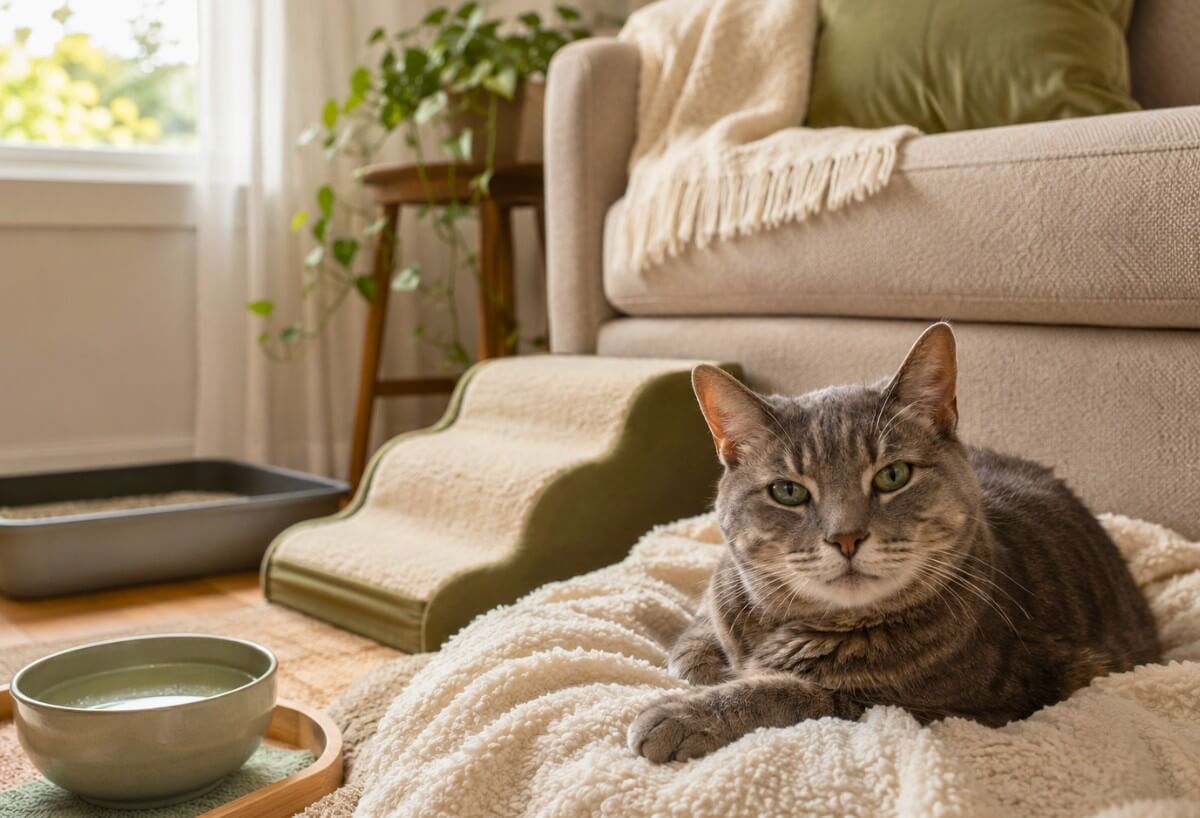
Depending on your cat’s illness, your vet may discuss pain relief, anti-nausea medication, appetite support, fluids, diet changes, mobility help, constipation management, wound care, breathing support, or ways to reduce stress at home.
Sometimes small changes make a real difference.
A lower-sided litter box.
A warmer sleeping place.
Food served slightly warmed.
A quiet room away from other pets.
A ramp or step to a favorite chair.
Medication that helps increase appetite.
Pain relief that lets your cat rest properly.
A routine that makes them feel safe.
These things may not sound dramatic.
But to a sick cat, they can be everything.
Comfort care says:
Your life still matters.
Your body still deserves relief.
Your days are still worth tending gently.
That’s not giving up.
That’s love becoming very practical.
Be careful with “natural remedies” — but don’t feel silly for wanting more support
When your cat is seriously ill, it’s completely natural to look for more.
More options.
More comfort.
More time.
More hope.
Many cat parents become interested in complementary therapies at this point.
That might include acupuncture, massage, reiki, herbal support, supplements, homeopathy, or working with a holistic vet.
I understand that urge very deeply.
When Moofy was ill, I explored complementary support too.
I’ve written separately about the natural and complementary support I used while Moofy was living with cancer, including what I felt helped her and how I approached it alongside her veterinary care.
Some of these treatments helped us feel calmer.
Some of them gave our days a rhythm.
Some of them made me feel less helpless.
And some practitioners we met were kind, thoughtful, and genuinely supportive.
But this part needs to be said clearly:
Complementary care should not replace veterinary care for a seriously ill cat.
Cats are sensitive little creatures.
Some herbs, essential oils, human supplements, and “natural” products can be unsafe for them.
Some can interfere with medications.
Some can delay pain relief or proper treatment if they’re used instead of medical care.
So if you want to explore complementary options, the safest route is to involve your vet, or work with a qualified holistic veterinarian who understands both conventional medicine and complementary support.
A good practitioner should not promise miracle cures.
They should not pressure you.
They should not tell you to ignore your vet.
They should be willing to work around your cat’s diagnosis, medications, stress levels, and comfort.
The goal is not to throw everything at your cat because you’re terrified.
The goal is to support your cat gently, safely, and thoughtfully.
Shift from “How long?” to “How well?”
When your cat has an incurable illness, the question that haunts you is usually:
How long do we have?
Of course it is.
You love them.
You want more time.
You want the calendar to slow down.
You want someone to tell you whether you’re looking at days, weeks, months, or years.
Sometimes your vet may be able to give you a rough idea.
But no one can predict everything.
Some cats decline faster than expected.
Some do better than anyone thought they would.
Some have ups and downs.
Some seem steady for a while and then change suddenly.
That uncertainty is very hard to live with.
So while “How long?” is an understandable question, it can’t be the only one.
Another question is:
How well is my cat living today?
Are they comfortable?
Are they eating enough?
Are they drinking?
Can they rest?
Can they move without distress?
Are they still interested in you, their routines, their favorite places, or small pleasures?
Are they having more good days than bad ones?
This doesn’t mean you ignore the future.
It means you don’t let fear of the future steal the time your cat still has now.
Cats live close to the present moment.
They don’t sit there worrying about a diagnosis the way we do.
They know whether they feel safe.
They know whether they hurt.
They know whether they want food, warmth, quiet, company, or space.
When you focus on quality of life, you come back to the cat in front of you.
Not the imagined goodbye.
Not the worst-case scenario.
This cat.
This day.
This small, precious life.
Keep a simple quality-of-life record
When you’re frightened, it can be hard to judge how your cat is really doing.
One bad day can make you panic.
One good morning can make you question everything.
That’s why a simple record can help.
You don’t need anything complicated.
A notebook, phone note, or comments on a printed calendar is enough.
Each day, write down a few basics:
Did your cat eat?
Did they drink?
Did they use the litter box?
Did they seem comfortable?
Did they hide more than usual?
Did they interact with you?
Did they enjoy anything today?
Did they seem painful, restless, nauseous, weak, or distressed?
You can also give the day a simple rating:
Good day.
Mixed day.
Bad day.
Over time, patterns become clearer.
This can help you and your vet adjust the care plan.
It can also help later, if you have to make a heartbreaking decision about euthanasia.
Because when you’re deep in love and fear, you may not remember clearly.
The record can gently show you whether your cat is mostly living, or mostly struggling.
That can be painful to see.
But it can also be a mercy.
Let your cat teach you what still matters
A sick cat may not need grand gestures.
They may need the ordinary things, made easier.
Their favorite blanket washed and placed in a sunny spot.
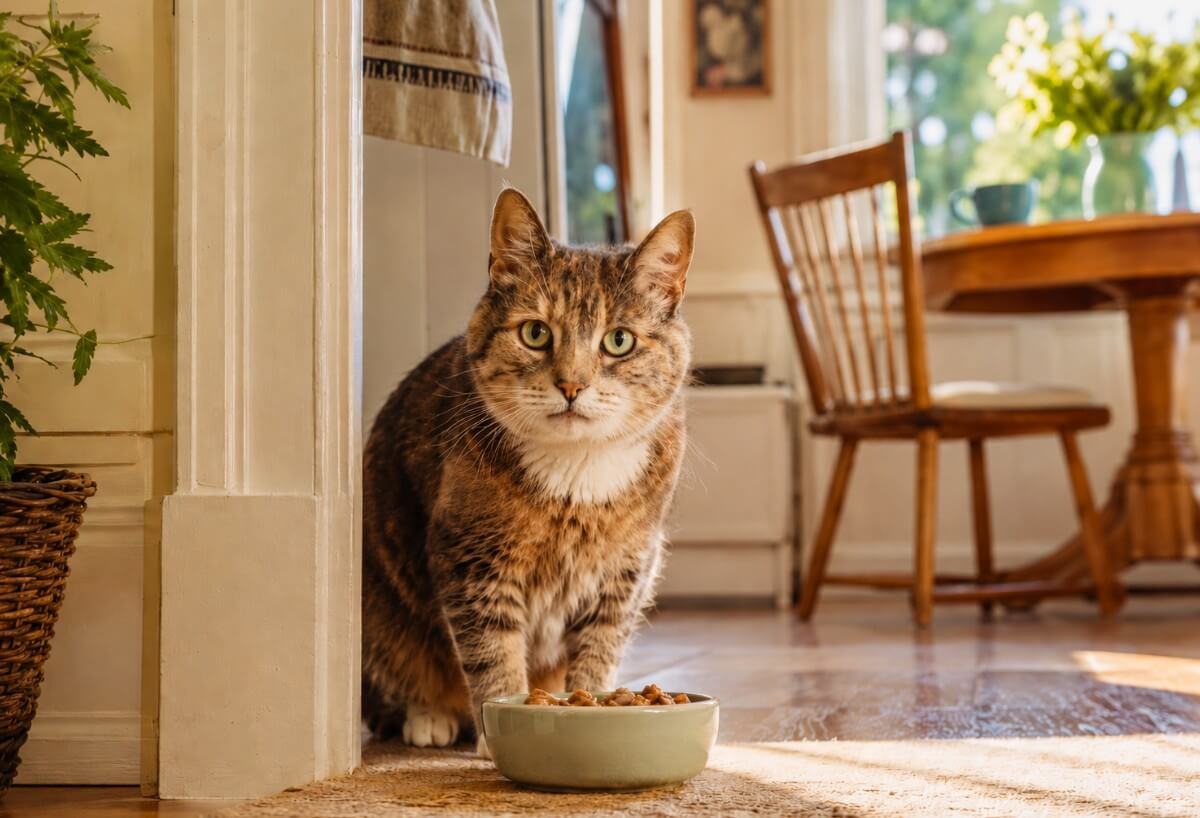
A food bowl brought closer.
A quiet room when visitors come.
A soft voice.
A warm lap.
A familiar smell.
A gentle hand resting nearby.
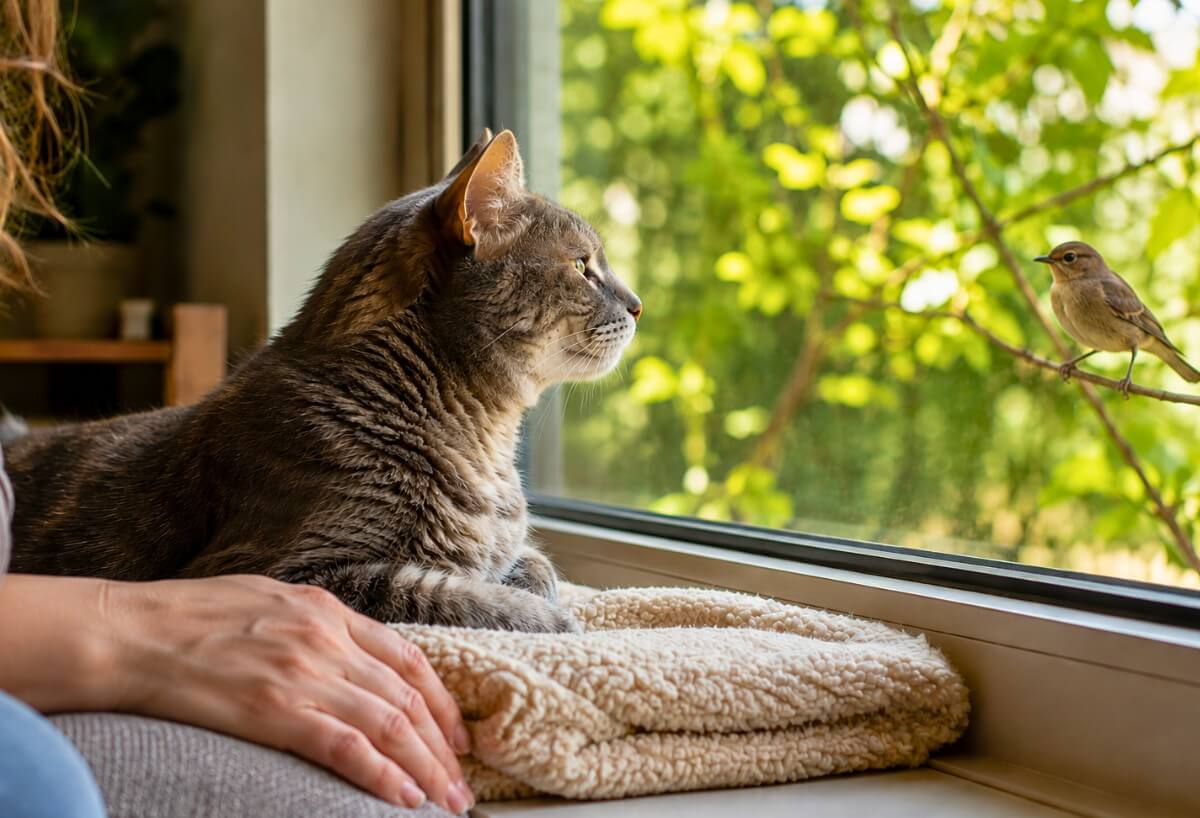
A chance to sit in the garden, sniff the air, or watch birds through the window.
When Moofy was living with cancer, one of the things that stayed with me was how alive she still was.
She wasn’t sitting around thinking of herself as a tragic case.
She was busy being Moofy.
She still wanted attention.
She still had opinions.
She still climbed the living room curtains joyfully.
She still sat on my lap, looked into my eyes, and smiled at me.
That mattered.
It didn’t erase the illness.
But it reminded me that her life was not only about the illness.
Your cat is not a diagnosis.
Your cat is the creature who knows the sound of your footsteps.
The one who has favorite sleeping places.
The one who has habits, preferences, moods, and tiny rituals that belong only to them.
Illness may change what they can do.
But while they’re still here, there may still be ways to help them feel like themselves.
Don’t confuse acceptance with giving up
At some point, you may have to accept that your cat’s illness cannot be cured.
That acceptance can feel unbearable.
It may feel like betrayal.
Like you’re letting the disease win.
Like you’re supposed to keep searching, keep trying, keep fighting, keep proving how much you love them.
But acceptance is not the same as abandonment.
Sometimes acceptance means you stop chasing a miracle and start protecting your cat from unnecessary stress.
Sometimes it means you choose comfort over invasive treatment.
Sometimes it means you stop asking your cat to endure things for your sake.
Sometimes it means you love them enough to see what is true.
That’s not weakness.
That’s one of the hardest forms of love there is.
You can still hope.
You can still care.
You can still try.
But you can also let your cat’s comfort become more important than your fear.
Build a care team you trust
You shouldn’t have to carry this alone.
If your cat has a serious illness, think about who belongs in your support circle.
That may include your regular vet, a specialist, a holistic vet, a veterinary nurse, a palliative care or hospice vet, a trusted friend, or someone who has been through pet loss before.
You need people who can help you think clearly when you’re overwhelmed.
You need people who won’t dismiss your grief.
You need people who understand that your cat is family.
And you need professionals who will tell you the truth kindly.
A good care team doesn’t just focus on the disease.
They also care about your cat’s comfort, your questions, your limits, and the emotional weight of making decisions for someone you love so much.
If you feel rushed, shamed, brushed off, or unable to ask questions, it’s okay to look for more support.
You’re not being dramatic.
You’re trying to do right by your cat.
Make the time feel like love, not a countdown
After a serious diagnosis, it’s easy to start living in countdown mode.
You watch every movement.
You monitor every bite of food.
You tense up when they sleep deeply.
You wonder if each cuddle is one of the last.
That painful awareness that you may be approaching a goodbye has a name: anticipatory grief.
It can begin long before your cat dies and make even beautiful moments feel frighteningly fragile.
It’s totally understandable.
But it’s also exhausting.
If you recognize yourself in that constant watching and checking, When Your Cat Is Sick and You Can’t Stop Worrying looks more closely at how frightening and exhausting that kind of vigilance can become.
And your cat may still be here, asking for an ordinary day.
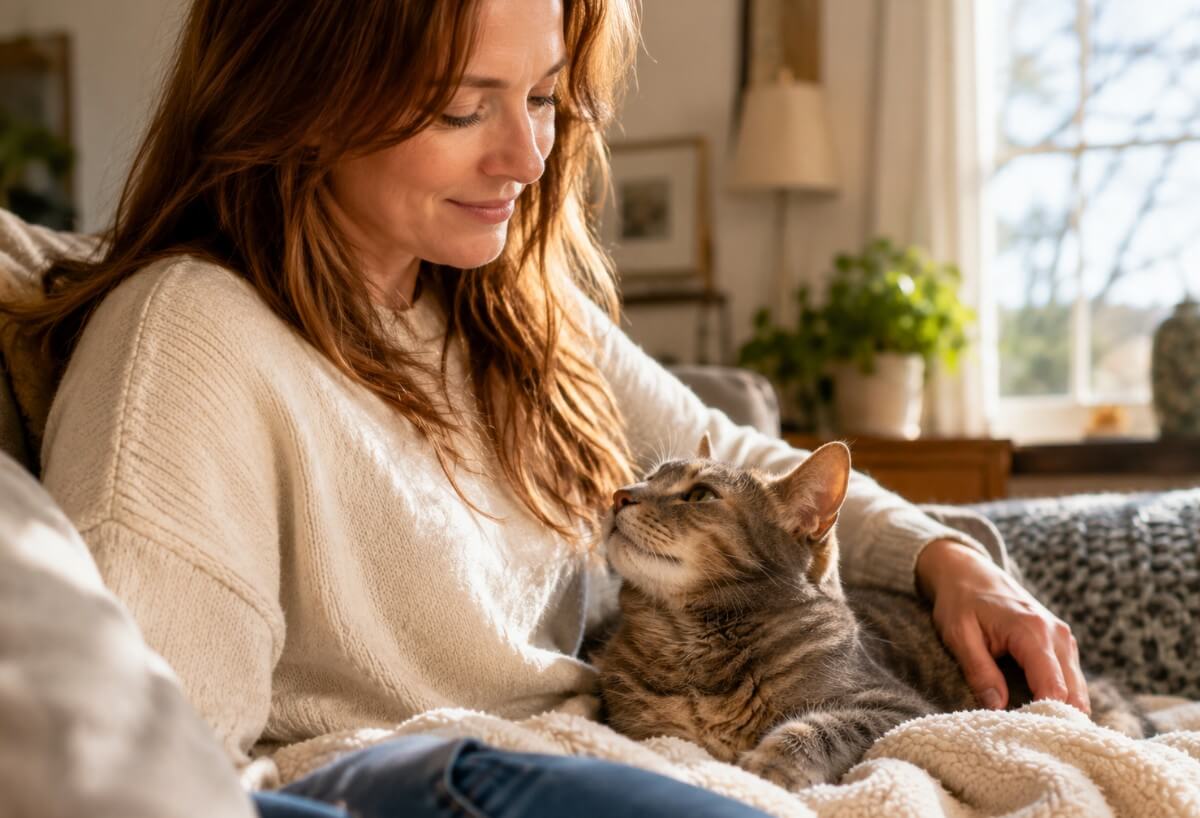
So try to make some room for love that isn’t only medical.
Take photos if that feels comforting.
Sit with them without checking symptoms every minute.
Let them enjoy small pleasures if they safely can.
Talk to them.
Brush them if they like it.
Open the curtains.
Let them be near you.
Let yourself notice the good moments without immediately bracing for the bad ones.
You’re allowed to enjoy your cat while they are ill.
You’re allowed to laugh at something funny they do.
You’re allowed to feel grateful for a good day.
Joy during illness is not denial.
It’s part of loving them while they’re still here.
When the illness progresses
There may come a time when comfort care is no longer enough.
That’s the part no one wants to face.
Your cat may stop eating.
Pain may become harder to control.
Breathing may change.
They may withdraw from everything they once enjoyed.
They may have more bad days than good ones.
They may seem tired in a way that rest doesn’t fix.
If that happens, it’s time to speak honestly with your vet.
Not because you have failed.
Because your cat’s needs may be changing.
Euthanasia can be one of the most painful decisions a cat parent ever makes.
But when a cat is suffering and there is no good way to bring them back to comfort, it can also be a final act of protection.
If you’re starting to wonder whether you may be reaching that point, How Do You Know When It’s Time to Euthanise a Cat? goes through the decision gently and in much more detail.
You don’t have to make that decision alone.
Ask your vet what they’re seeing.
Ask what signs would concern them.
Ask whether there are still realistic comfort options.
Ask what waiting might mean for your cat.
The goal is not to choose the longest possible life at any cost.
The goal is to protect the cat you love from unnecessary suffering.
Your cat’s illness is not the whole story
Some feline diseases can’t be cured.
That’s a heart-breaking truth.
But in the meantime…
Your cat may still have comfort.
Your cat may still have pleasure.
Your cat may still have routines, preferences, trust, and love.
Your cat may still have time that matters deeply.
When Moofy was diagnosed with cancer, I thought I was being pulled straight into an ending.
But what followed was also a chapter of intense closeness.
And we had almost two more years together.
Those days were not easy.
Not perfect.
And definitely not free from fear.
But each one was full of love.
I learned that caring for a cat with an incurable illness is not only about trying to stop death.
It’s about helping life remain as gentle, safe, and meaningful as possible while life is still here.
So if your cat’s illness can’t be cured, please don’t hear that as:
There’s nothing left to do.
Hear it as:
The kind of care my cat needs is changing.
You can still ask questions.
You can still seek support.
You can still manage symptoms.
You can still make today softer than it might have been.
And your cat will feel that.
Not as a grand gesture.
Not as a promise that everything will be all right.
But in the warm blanket.
The familiar hand.
The quiet room.
The food offered patiently.
The pain noticed early.
The small adjustments made with love.
When a disease cannot be cured, care still matters.
It matters in the hours your cat is more comfortable.
It matters in the fear you help soften.
It matters in the ordinary moments you keep safe.
You may not be able to change the diagnosis.
But you can still change what this day feels like for your cat.
And when time is limited, that’s not a small thing.
Frequently Asked Questions
What does it mean if my cat’s illness can’t be cured?
If your cat’s illness can’t be cured, it usually means the underlying condition can’t be completely removed, reversed, or permanently fixed.
But that doesn’t always mean there’s nothing to do.
Some incurable conditions can still be managed for a time with medication, comfort care, diet changes, monitoring, or supportive treatment.
Your vet can help you understand whether the goal is slowing the illness, managing symptoms, reducing pain, or protecting quality of life.
Should I get a second opinion if my cat has an incurable illness?
Yes, a second opinion can be very helpful, especially if the diagnosis is serious, confusing, or emotionally overwhelming.
A second vet may confirm the original diagnosis, which can bring peace of mind, or they may suggest further testing, symptom control, specialist care, or palliative options.
Getting another opinion doesn’t mean you don’t trust your vet.
It means you’re trying to make the most informed decision for your cat.
Can cats live with incurable diseases?
Some cats can live with incurable diseases for weeks, months, or even years, depending on the condition, how advanced it is, and how well symptoms can be managed.
Chronic kidney disease, some cancers, heart disease, arthritis, and other long-term illnesses may not always be curable, but some cats can still have meaningful quality time with the right care.
Your vet is the best person to help you understand your cat’s likely outlook.
Is palliative care the same as giving up on my cat?
No. Palliative care is not giving up.
It means the focus shifts from curing the disease to keeping your cat as comfortable, safe, and peaceful as possible.
This may include pain relief, nausea control, appetite support, easier access to food and litter, stress reduction, and regular quality-of-life checks.
Palliative care can be a deeply loving and active form of care.
Are natural remedies safe for cats with serious illnesses?
Some complementary approaches may be gentle and supportive, but “natural” does not automatically mean safe for cats.
Cats can be very sensitive to herbs, essential oils, supplements, and human products.
Some natural remedies may also interfere with medication or delay proper veterinary treatment.
Always talk to your vet before giving your cat any supplement, herb, or alternative treatment, especially if your cat is seriously ill.
How do I know if my sick cat still has quality of life?
Quality of life is usually about patterns, not one single moment.
Look at whether your cat is eating, drinking, resting comfortably, using the litter box, moving without distress, interacting with you, and still enjoying some familiar pleasures.
It can help to keep a simple daily record of good days, mixed days, and bad days.
If your cat is having more bad days than good ones, or pain and distress can’t be controlled, it’s time to talk honestly with your vet.
When should I consider euthanasia for a cat with an incurable illness?
Euthanasia may need to be considered when your cat is suffering and comfort can no longer be maintained.
Signs may include ongoing pain, difficulty breathing, repeated distress, refusal to eat, severe weakness, loss of interest in everything they once enjoyed, or more bad days than good ones.
This is an incredibly painful decision, and you shouldn’t have to make it alone.
Ask your vet what they’re seeing, what can still be managed, and what waiting may mean for your cat.
What can I do today if my cat’s illness can’t be cured?
Start with one gentle, practical step.
Call your vet with your questions.
Make your cat’s favorite resting place warmer or easier to reach.
Offer food in a way that feels less stressful. Keep a simple quality-of-life note.
Sit with your cat without trying to fix everything at once.
When a cure isn’t possible, small acts of comfort still matter.
Further Reading
When your cat is living with an incurable illness, the medical decisions are only part of what you’re carrying.
These guides may help with some of the emotional questions that often come next.
Anticipatory Grief for a Cat: How to Cope Before Goodbye
Grief can begin while your cat is still beside you.
This article looks at why that happens and how to live with the fear of losing your cat without letting it take over all the time you still have together.
How Do You Know When It’s Time to Euthanise a Cat?
When comfort becomes harder to maintain, knowing when to let a cat go can feel impossible.
This guide walks gently through quality of life, signs to watch for, and the difficult question of when it may be time.
Caring for a Sick Cat: How Illness Can Deepen Your Bond
Serious illness changes everyday life with your cat, but it can also bring an extraordinary kind of closeness.
This piece is about the bond that can grow through all those small acts of care.

If your cat is living with an illness that can’t be cured, I’m so sorry. It is a deeply painful place to be.
This article is not about giving up. It’s about the care that still matters when a cure is no longer possible: comfort, pain relief, second opinions, honest conversations with your vet, and making each day as gentle as you can.
If you’re in this situation, please know you’re not failing your cat because you can’t fix everything. Sometimes love becomes quieter than that. Sometimes it becomes noticing, adjusting, comforting, asking questions, and staying present.
You’re welcome to share your cat’s name here if you’d like to. I’ll be holding you both in my thoughts.
Hi Liz,
Just wanted to say thanks again for this article. My 7 month old kitten has possible fips and we’re not ready to give up on him yet. Hopefully my Rocco has the same zest for life as your Moofy! Cheers Heather (from twitter) xx
http://www.myspanishvida.wordpress.com
Glad it helped, Heather; there’s so much you can do to help him. I always suggest a holistic vet as a good place to start – they know both conventional and alternative approaches, so you get twice the options. Talk to Rocco and tell him what’s going on – it sounds crazy but I think it’s important. Hang in there xx
I know vet bills can be expensive, but I what about pet insurance? I’ve done some research online and some friends have told me about it.
Pet insurance is a great idea if it’ll help people access surgery their cats need, for sure. In our case, surgery wouldn’t have helped (the tumor would keep coming back and it was right near Moofy’s spine so too dangerous to operate in any case).
This was so helpful
I’m so pleased it helped you, Diane; it’s such an upsetting time. Your cat knows that you’re trying to help!