

The First Few Days After Losing a Cat: What Grief Feels Like
The first few days after losing a cat can feel strangely unreal.
You may have known the loss was coming.
Your cat may have been old, ill, or declining for a long time.
You may have spent weeks preparing yourself, speaking to the vet, watching symptoms, making decisions, and trying to be brave.
But even when the death itself is not a shock, the absence often is.
The house can feel wrong in ways you didn’t expect.
You may keep looking toward your cat’s usual places — the bed by the window, the chair, the bowl, the patch of sun, the end of the sofa — and feel the loss hit you again each time.
You may still listen for familiar sounds.
You may catch yourself thinking it’s time to feed them, check on them, open a door for them, or move carefully so you don’t disturb them.
Then you remember.
That repeated remembering can be one of the most painful parts of early grief.
It can feel as though your mind understands what happened, but your body and routines haven’t caught up yet.
If the first few days feel confusing, physical, empty, guilty, numb, or overwhelming, you’re not grieving wrong.
You’re adjusting to a real loss — one that has changed not only how you feel, but how your ordinary life works.
The short answer
Cat grief in the first few days can feel like shock, disbelief, emptiness, guilt, exhaustion, brain fog, numbness, crying, restlessness, or a painful awareness of all the places your cat should be. You may feel overwhelmed by ordinary routines or triggered by small reminders around the house. This doesn’t mean you’re coping badly. It means your mind and body are trying to understand the absence of a cat who was deeply woven into your daily life.
Why the first few days can feel so unreal
When a cat dies, the loss is not only emotional.
It is also practical, sensory, and deeply tied to routine.
Your cat may have shaped your mornings, your evenings, your work breaks, your bedtime, your movements through the house, and the way your home felt when you came through the door.
Even a quiet cat takes up space.
They change the atmosphere of a room simply by being in it.
That’s why the first few days can feel so disorienting.
Nothing may look dramatically different to someone else, but everything feels different to you.
The same rooms are there.
The same furniture is there.
The same light comes through the windows.
But the small presence that made the house feel alive is gone.
This is especially hard because your habits don’t disappear the moment your cat dies.
You may still turn toward them automatically.
You may still expect them at certain times of day.
You may still avoid stepping in a place where they used to sleep, or glance toward their food bowl before your mind catches up.
These moments can be heartbreaking, but they’re also understandable.
Your brain is still following the patterns of love and care it learned over months or years.
The house may feel painfully quiet
One of the hardest parts of early cat grief is the silence.
Cats are often quiet companions, but their presence has a rhythm.
The sound of paws on the floor.
The small thump of jumping down from furniture.
The scratching at a door.
The rustle of bedding.
The meow from another room.
All those tiny ordinary sounds you may not have noticed until they stopped.
After your cat dies, the house can feel too still.
Not peaceful, necessarily. Just empty.
You may notice the places where your cat used to be with a kind of sharpness.
Their bed may look unbearable.
Their bowl may feel impossible to move.
Their favorite blanket may seem both comforting and devastating.
You may want to keep everything exactly as it was, or you may want to put things away because seeing them hurts too much.
There’s no correct way to respond to those reminders in the first few days.
Some people sit near their cat’s favorite spot because it still feels close to them.
Others avoid certain rooms because the absence feels too loud.
Both reactions are normal.
Early grief often lives in the ordinary corners of the house.

You may feel your cat everywhere
Many people are surprised by how strongly they still sense their cat in the first few days after death.
You may think you hear them.
You may see movement out of the corner of your eye and, for a split second, expect them to be there.
You may wake up and briefly forget they’re gone.
You may walk into a room and feel the old expectation before the loss lands again.
This doesn’t mean something is wrong with you.
It doesn’t mean you’re not accepting reality.
It means your mind is still used to searching for someone who was part of your everyday world.
For a long time, you probably kept track of your cat without even realizing it.
You knew where they slept, when they ate, what sounds they made, how they asked for things, and which tiny changes meant something was wrong.
That awareness doesn’t switch off immediately.
In the first few days, your mind may still look for them because it loved them, cared for them, and expected them to be there.
Grief may make ordinary tasks feel hard
Early grief can make the simplest parts of life feel strangely difficult.
You may struggle to get out of bed, make food, reply to messages, go to work, clean the kitchen, or carry on a normal conversation.
You may find yourself standing in the middle of a room, unable to remember what you were doing.
You may feel as though everything takes more effort than it should.
This can be especially true if your cat was sick before they died.
Caring for an elderly or unwell cat often creates an intense routine.
You may have been managing medication, vet appointments, special food, litter box changes, pain symptoms, breathing, appetite, mobility, or the constant question of whether your cat was comfortable.
Then suddenly, that routine stops.
There’s no medication to give.
No symptoms to check.
No decision to make that morning.
No appointment to prepare for.
No need to watch every movement and wonder what it means.
The absence of caregiving can feel like its own shock.
You may feel grief, relief, guilt, exhaustion, and confusion all tangled together.
The space that used to be filled with worry may now feel empty, and that emptiness can be very hard to sit with.

Cat grief can feel physical
Grief is not only sadness.
It can affect your whole body.
In the first few days, you may feel heavy, shaky, drained, restless, sick, tense, or unable to settle.
You may have headaches or a tight chest.
Your appetite may disappear, or you may find yourself eating without really tasting anything. Sleep may be difficult, or you may feel as though you could sleep for days.
This can be frightening if you expected grief to feel purely emotional.
But the body often reacts strongly to loss, especially when the relationship was part of daily life.
Your nervous system has been through a shock.
Your routines have changed.
Your home feels different.
Your sense of normal has been disrupted.
Try to be gentle with yourself if your body feels strange.
In the first few days, the goal is not to cope perfectly.
It’s to meet your most basic needs as kindly as you can.
Drink some water. Eat something simple.
Rest when you can.
Step outside for a few minutes if that feels possible.
Let yourself move slowly.
You don’t have to be strong in a polished way.
You just have to keep taking the next small step.
You may feel numb instead of devastated
Not everyone cries constantly in the first few days.
Some people feel numb.
They move through the practical tasks, answer messages, speak to the vet, clean up, make arrangements, or go back to work feeling strangely blank.
They may even worry that their numbness means they didn’t love their cat enough.
It doesn’t.
Numbness can be a protective response.
Sometimes the mind only lets in as much pain as it can manage at once.
The grief may come later, or it may arrive in waves — when you see the bowl, change the sheets, open a cupboard, come home from work, or realize there’s no-one waiting for you.
You don’t need to force tears to prove love.
If you feel numb, you’re still grieving.
Your mind may simply be giving you a little distance from the full weight of the loss until you’re able to feel more of it.
Guilt is very common in the first few days
Guilt often arrives quickly after a cat dies, especially if you had to make decisions about treatment, euthanasia, timing, or end-of-life care.
You may replay the final days again and again.
You may wonder whether you waited too long, chose too soon, missed a sign, should have asked another question, should have noticed something earlier, or should have done more. Even if other people reassure you, your mind may keep returning to the same painful questions.
This kind of guilt can feel convincing, but it often isn’t telling the truth.
After a loss, the mind often searches for control.
It tries to find the exact moment where things could have gone differently, because that can feel less frightening than accepting that illness, age, decline, accidents, and death are sometimes beyond our power to fix.
You may see things differently now because grief gives you a harsh kind of hindsight.
But you made decisions with the information, strength, time, money, veterinary guidance, and emotional capacity you had at the time.
Loving your cat made you responsible for their care.
It didn’t mean you could control everything that happened to them.
You may feel relief and then feel ashamed
If your cat had been very sick, very elderly, or suffering, you may feel some relief after they die.
This can be one of the most painful and confusing parts of early grief.
You may feel relief that your cat is no longer struggling.
Relief that the decision is over.
Relief that you no longer have to watch every symptom, dread every morning, or wonder whether today will be worse.
Relief that the crisis has ended.
Then, almost immediately, guilt may follow.
You may ask yourself how you could possibly feel relieved when your cat is gone.
But relief doesn’t mean you wanted them gone.
It means some part of your body understands that the suffering, uncertainty, and constant vigilance have stopped.
You can miss your cat desperately and still feel relief that they’re no longer in pain.
You can be heartbroken and exhausted at the same time.
You can be grateful that their suffering has ended and devastated that their life has ended too.
Grief is rarely one clean feeling.
In the first few days, it may be a tangle of emotions that seem to contradict each other.
That doesn’t make any of them wrong.

Other people may not understand the depth of it
One of the loneliest parts of losing a cat is realizing that not everyone understands what has been lost.
Some people may be kind but awkward.
Others may say things that are meant to help but land badly.
They may remind you that your cat had a good life, that they were old, that you did the right thing, or that you can get another cat one day.
Those statements may be true, but they may not comfort you in the first few days.
When grief is raw, you may not need explanations.
You may simply need someone to understand that your cat mattered.
That they were not replaceable.
That they were not just part of the furniture.
That their absence has changed your home and your heart.
It’s okay to protect yourself from people who minimize the loss.
You don’t have to explain the depth of your bond to everyone.
It may be enough to choose one safe person and tell them the truth: “I’m really struggling. I don’t need advice.
I just need you to know how much I miss them.”
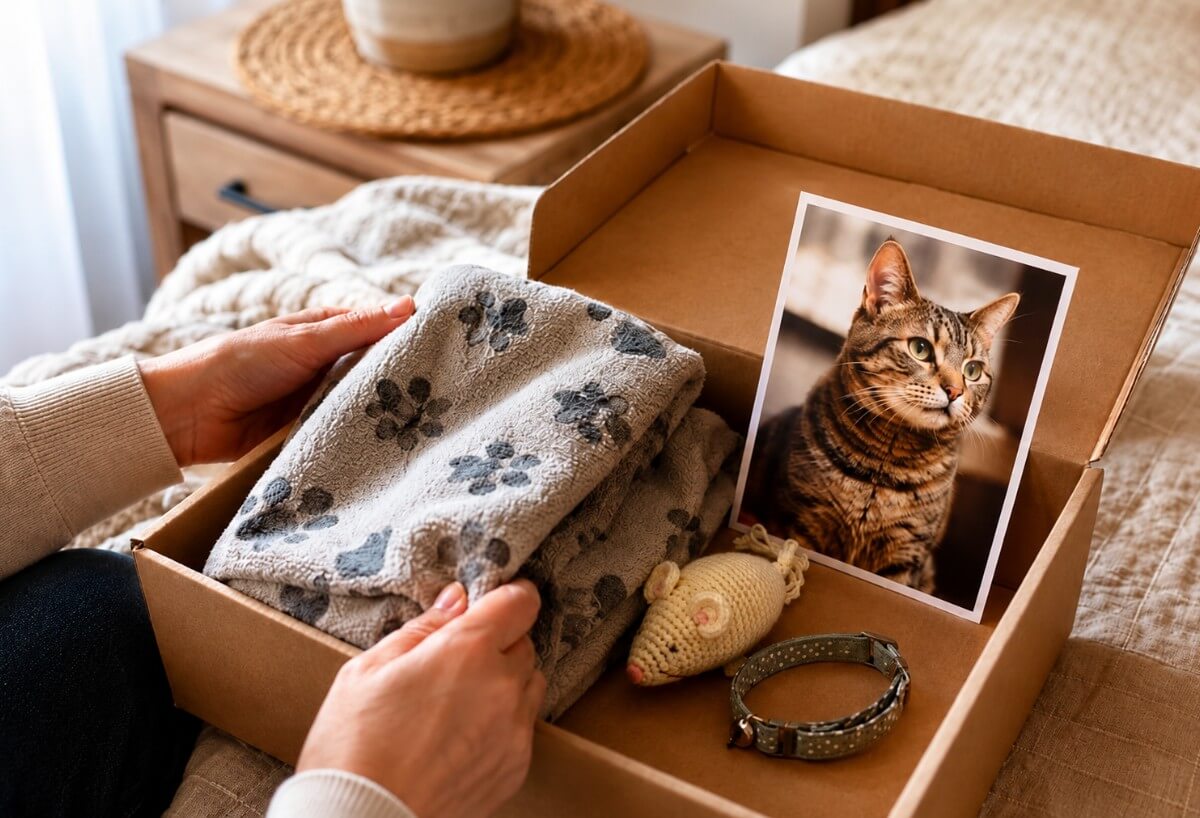
Your cat’s things may feel impossible to deal with
In the first few days, your cat’s belongings can become emotionally loaded in ways that are hard to explain.
A bowl may feel unbearable.
A blanket may feel precious.
A litter box may feel like too much to face.
A toy under the sofa may undo you.
Leftover food, medication, bedding, fur, carriers, and favorite spots can all carry the weight of the loss.
You may want to leave everything exactly where it is because moving it feels like a second goodbye.
Or you may need to put some things away because seeing them is too painful.
Neither response means you loved your cat more or less.
You don’t have to make permanent decisions right away.
You can put things in a box and decide later.
You can keep a blanket out.
You can ask someone else to remove items you can’t bear to handle.
You can donate food when you’re ready.
You can leave their favorite spot untouched for a while.
Early grief is not the time to bully yourself into “moving on.”
You’re allowed to move gently.
The first few days are not a test
It’s easy to feel as though you should be coping in a certain way.
You may think you should be calmer, more productive, less emotional, more spiritual, more accepting, or more grateful. You may compare yourself to other people and wonder why you’re not handling it better.
But the first few days after losing a cat are not a test of strength.
They’re the beginning of learning how to live with a painful absence.
You don’t have to sort every object, answer every message, make meaning out of the loss, or know what comes next.
You don’t have to turn your grief into something beautiful right away.
You don’t have to be okay because other people are uncomfortable with your sadness.
For now, it may be enough to get through the next hour, the next meal, the next night, and the next morning.
That’s not failure.
That’s grief.
What may help in the first few days
Nothing will make the first few days painless, but small acts of care can make them a little more survivable.
Try to keep one simple routine if you can.
It might be making tea in the morning, opening the curtains, taking a shower, stepping outside, or eating something basic.
You don’t need to rebuild your whole life.
You only need one small anchor.
It may also help to tell one safe person how you’re really doing.
Not everyone deserves access to your grief, but one kind witness can make the loneliness feel less absolute.
If your cat’s things are making your hurt worse, consider moving only the most difficult items to a temporary place.
This isn’t erasing your cat.
It’s giving yourself a little breathing room while the grief is raw.
Writing can also help if your mind keeps replaying the final days.
You might write down what happened, what the vet told you, what you chose and why, and what you want to remember about your cat beyond the ending.
This doesn’t have to be polished or organized.
It just gives some of the pain a place to go.
And if it helps, say your cat’s name.
Talk about them. Tell a story. Cry.
Laugh at something ridiculous they used to do.
Your cat’s life was more than the day they died, and their name still belongs in your world.

When to reach for extra support
Grief can be intense in the first few days, and deep sadness after losing a cat is not automatically a sign that something is wrong.
But please reach out for extra support if you feel unable to function at all, if you can’t eat or sleep for several days, if panic feels unmanageable, if you feel completely alone, or if you’re having thoughts of harming yourself or not wanting to be here.
You can speak to a doctor, therapist, grief counselor, pet loss support line, crisis line, or trusted person who can stay with you.
Needing help does not mean you’re weak.
It means the grief is too heavy to carry alone right now.
Your cat mattered.
And you matter too.
You won’t always feel exactly like this
In the first few days, it can feel as though the pain will always be this sharp.
The house may feel unbearably empty.
Mornings may feel awful.
Coming home may hurt.
Every small reminder may seem to open the wound again.
Grief doesn’t disappear quickly, and love doesn’t end because a certain number of days have passed. But the first raw intensity usually changes.
Not because you forget your cat, and not because you stop missing them, but because your mind and body slowly begin to understand what has happened.
At first, their absence may be the only thing you can feel.
Later, little by little, there may be more room for the rest of their life: their habits, their personality, their comfort, their funny ways, their favorite places, and the love that existed before the final goodbye.
You don’t have to reach that place immediately.
For now, you only have to get through these first days gently.
Final thought
If the first few days after losing your cat feel unreal, confusing, physical, guilty, or unbearably quiet, you’re not doing anything wrong.
You’re grieving a real relationship.
The empty bowl hurts because there was love there.
The quiet hurts because there was presence there.
The routine hurts because there was care there.
Your cat was not “just a cat.”
This was your cat.
And the grief you feel now is part of the love you shared.
Frequently Asked Questions
Is it normal to feel this devastated after losing a cat?
Yes. It can be completely normal to feel devastated after losing a cat, especially if your cat was part of your daily life for years.
Cats are companions, routines, family members, and emotional anchors.
The grief can feel intense because the loss affects your home, your habits, and your sense of comfort.
Why do the first few days after losing a cat feel so unreal?
The first few days can feel unreal because your mind and body are still adjusting to your cat’s absence.
You may still expect to hear them, feed them, check on them, or see them in their usual places.
Your routines may understand the loss more slowly than your mind does.
Is it normal to feel numb after my cat dies?
Yes. Numbness is a common response to grief.
It doesn’t mean you didn’t love your cat enough.
Sometimes the mind protects you by only letting in part of the pain at first.
The grief may come later, in waves, or when small reminders make the loss feel real again.
Why do I feel guilty after my cat died?
Guilt is very common after a cat dies, especially if you had to make decisions about treatment, euthanasia, timing, or care.
Grief often makes people replay the final days and search for something they could have done differently.
Feeling guilty does not automatically mean you did something wrong.
Is it wrong to feel relieved after my cat dies?
No. Relief can be a normal part of grief, especially if your cat was suffering or if you had been living through a long period of worry and caregiving.
Relief doesn’t mean you wanted your cat gone.
It may simply mean the crisis, uncertainty, or suffering has ended.
What should I do with my cat’s things in the first few days?
You don’t have to decide right away.
You can leave your cat’s things where they are, move only the hardest items, place belongings in a temporary box, or ask someone else to help.
There’s no correct timeline for bowls, beds, blankets, toys, collars, or medication.
How long does cat grief last?
There is no fixed timeline for cat grief.
The first few days are often raw and disorienting, but grief may continue in waves for weeks, months, or longer.
It usually changes over time, but missing your cat does not mean you’re failing to heal.



If you’re in the first few days after losing your cat, I’m so sorry. These early days can feel painfully quiet, confusing and unreal, and you don’t have to make sense of everything yet.
You’re welcome to share a favourite memory, or simply how you’re feeling today. Sometimes it helps to know that someone else understands how much this loss can hurt.