
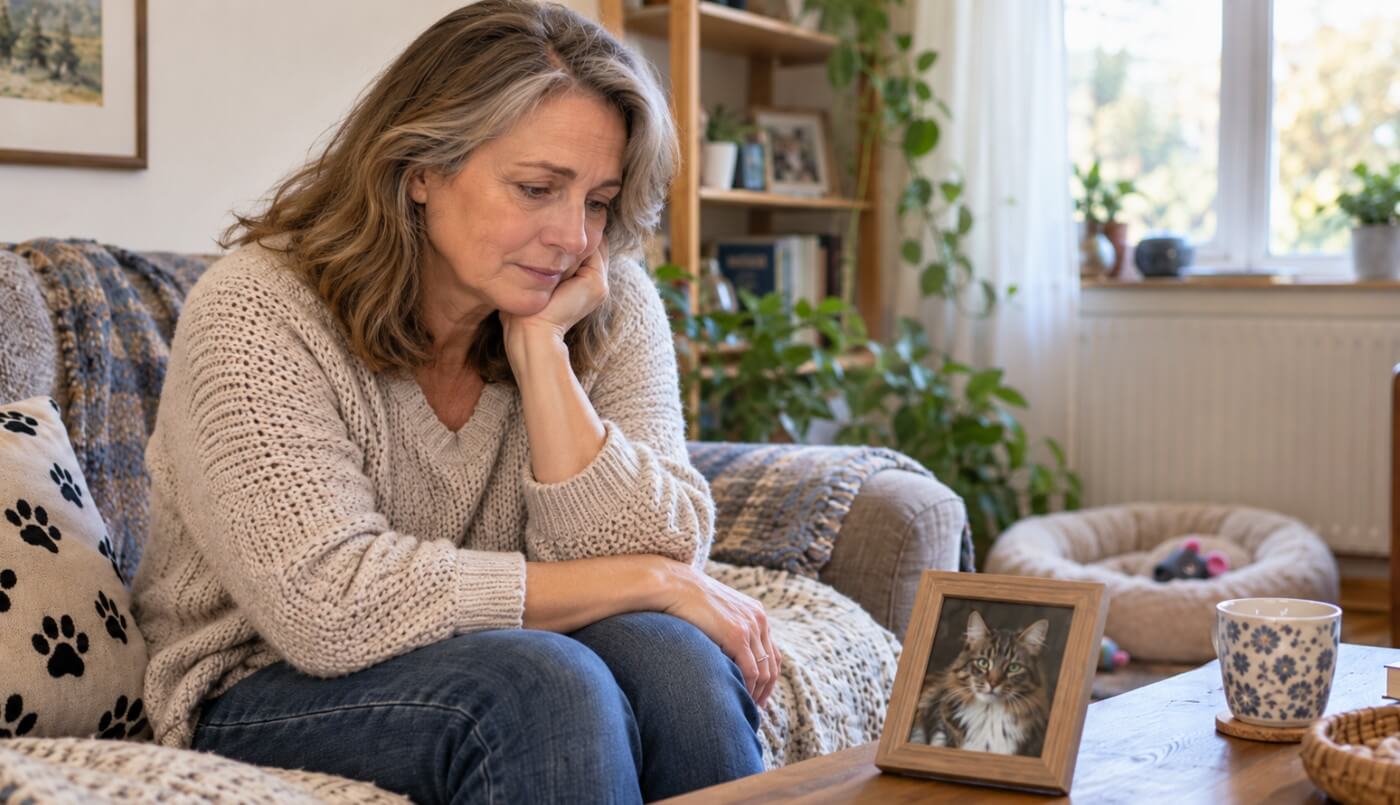
Did I Put My Cat to Sleep Too Soon?
After having a cat put to sleep, doubt can arrive very quickly.
At the time, you knew something was terribly wrong.
Perhaps your cat was very old, seriously ill, in pain, struggling with cancer or another disease, or simply reaching a point where life was becoming harder than it should be.
You talked to your vet.
You watched your cat.
You worried about every change.
Eventually, you made the decision you’d been dreading.
And then, after your cat died, another thought arrived:
What if I did it too soon?
Perhaps your cat was still eating.
They may have purred when you held them, walked into the kitchen that morning, looked out of the window, enjoyed a treat or curled up in their usual place.
Maybe their final day was actually quite a good day.
Now those moments are going around and around in your mind, and instead of reassuring you, they seem to be accusing you.
They were still enjoying things.
Maybe I could have had another week.
Maybe another month.
If this is where you are, there’s something important to understand.
The fact that your cat still had good moments doesn’t necessarily mean that euthanasia happened too soon.
And the terrible certainty you’re looking for now may be something no loving cat owner ever gets.
The Short Answer
There usually isn’t one exact, perfect day to euthanise a cat. If your cat was seriously ill, their quality of life was declining, and you made the decision with your vet to prevent further suffering, a good meal, a purr or even a relatively good final day doesn’t mean you chose too soon.
It means your cat was still capable of having good moments.
And that’s part of what made saying goodbye so unbearably difficult.
Why do I feel like I put my cat to sleep too soon?
Because once your cat is gone, your perspective changes.
Before the euthanasia, you were living with the whole situation.
You may have been watching medications stop working.
You knew what the vet had told you about the disease.
You noticed changes in sleeping, eating, grooming, toileting, breathing, movement or behaviour.
Perhaps you were getting up during the night to check your cat or lying awake wondering whether they were comfortable.
You weren’t making the decision on the basis of one morning.
You were making it on the basis of everything that had led to that morning.
But grief can compress all of that.
Afterwards, your mind may fix itself on one image:
She ate some chicken.
He walked outside.
She purred in my arms.
He watched me going about my day.
And suddenly the months or weeks of decline disappear from the argument.
All you can see is the cat you loved still being your cat.
A good last day can make the doubt worse
There’s something particularly cruel about this.
Of course we want our cat’s last day to be peaceful.
We want them comfortable, loved and maybe enjoying some favourite food or a warm patch of sunshine.
But when that happens, grief can later turn those lovely moments against us.
You remember your cat enjoying that piece of chicken and think:
How could I have euthanised a cat who still wanted chicken?
Yet the goal of euthanasia isn’t necessarily to wait until a cat can no longer experience anything pleasurable.
If we wait for every last good moment to disappear, a cat may already be experiencing considerable distress.
VCA Animal Hospitals’ guidance on end-of-life quality of life in cats recommends looking at the whole picture, including pain, hunger, hydration, hygiene, happiness, mobility and whether there are more good days than bad.
Your cat didn’t have to be miserable every second of the day for their illness to be serious.

But my cat was still eating…
This is one of the things grieving cat owners seem to come back to again and again.
They were still eating.
Surely that meant they weren’t ready to die?
Appetite matters enormously when assessing a sick cat.
But it’s only one part of quality of life.
Cornell’s Feline Health Center notes that euthanasia decisions are individual and should take into account what you’re seeing at home, your vet’s assessment, your cat’s prognosis and the treatment options available.
So yes, your cat may genuinely have enjoyed that last breakfast.
You don’t have to explain that memory away.
But eating breakfast doesn’t tell us everything about how a cat was feeling for the other 23 hours of the day — or what their illness was likely to bring next.
But my cat was still purring…
Purring can be even harder.
We associate a purring cat with happiness, safety and contentment.
When your memories include your cat purring beside you shortly before euthanasia, it can feel almost impossible to reconcile that with the decision you made.
But purring isn’t a reliable test of whether a cat is pain-free.
VCA Animal Hospitals notes that cats can purr for reasons other than contentment, and that unusual purring can be one of the behavioural changes seen in cats experiencing pain.
Cats are also very good at hiding discomfort.
That doesn’t mean your cat’s last purr wasn’t a happy one.
It may well have been.
Your cat may have felt safe because you were there, and being stroked may still have felt wonderful.
In that moment, life may genuinely have felt good.
You can keep that memory without asking it to prove that the decision was wrong.
A good moment is not the same as a good quality of life
This distinction can help.
A seriously ill cat can still enjoy things.
Your cat may still have wanted you nearby.
They may have enjoyed warmth, food, being brushed, being spoken to or lying on their favourite bed.
Those moments were real.
But a few good moments don’t tell you how your cat was coping overall.
When you made the decision, the bigger picture may have included questions such as:
- Was their pain or discomfort still being controlled?
- Were they breathing comfortably?
- Were they eating and drinking enough?
- Could they move around without significant distress?
- Were they able to use the litter tray normally?
- Could they keep themselves reasonably clean and comfortable?
- Were they still interested in their surroundings?
- Was treatment still helping?
- What was likely to happen next?
- Were the good days still outweighing the bad ones?
This is why the decision may have felt so difficult.
There often isn’t one dramatic moment when everything good disappears.
More often, you were trying to make sense of a gradual change in your cat’s comfort and quality of life.
What if my cat could have had another week?
Perhaps they could have.
That’s one of the hardest possibilities to live with.
There may have been another day available.
Maybe several days.
Sometimes perhaps longer.
But more time and more good time are not automatically the same thing.
When we grieve, we naturally imagine the extra time as good time.
Another week becomes another week of cuddles, favourite meals, sunshine and sleeping beside us.
We don’t instinctively imagine it as another week of nausea, breathlessness, pain, weakness, confusion, a crisis in the middle of the night or an emergency journey to the vet.
Yet those possibilities may have been part of what you were weighing when you made the decision.
You weren’t deciding between today and seven guaranteed wonderful days.
You were deciding whether to continue into a future whose quality you couldn’t know.
That’s a much more difficult decision.
I feel as though I stole time from my cat
This may be the most painful form of euthanasia guilt.
You wanted more time desperately.
Then somehow you became the person who chose not to take it.
It can feel completely contradictory.
But think about what you were actually choosing between.
You weren’t choosing between loving your cat and not loving them.
You were trying to decide how much further it was fair to ask their body to go.
The American Veterinary Medical Association explains that euthanasia can be a humane option when a pet is seriously ill, badly injured or experiencing a declining quality of life, and that your veterinarian can help you weigh up when that point may have been reached.
That doesn’t make the responsibility easy.
In some ways, it makes it harder.
If nature had simply made the decision for you, you wouldn’t be asking yourself whether you chose the wrong day.
There may never have been a perfect day
We often talk about euthanasia as though there’s a tiny window somewhere on a calendar.
Too soon.
THE RIGHT DAY.
Too late.
If only we could identify it.
Real life is rarely that neat.
Your vet can assess your cat’s health, discomfort and prognosis.
You can observe things at home that nobody else sees.
Quality-of-life tools can help you recognise patterns.
But there isn’t usually a blood test that says:
Tuesday is too early. Thursday is exactly right. Saturday is too late.
Cornell’s Feline Health Center notes that there are no strict rules that identify one exact right time for euthanasia.
The decision is usually made case by case, using both what you’re seeing at home and your vet’s assessment.
That uncertainty’s terribly difficult when you’re grieving, because grief wants certainty.
It wants a verdict.
And sometimes there simply isn’t one.
Try to remember what you knew then
If you’re convinced now that you made the decision too soon, try something that can be surprisingly revealing.
Go back mentally to the days before the appointment was made.
What was happening?
Not just on your cat’s best day.
Think about the whole picture.
What had your vet told you?
What treatments had been tried?
What symptoms were you watching?
What were you afraid was going to happen?
Were you keeping a quality-of-life diary?
Were you helping your cat eat, drink, groom, walk or use the litter tray?
Were medications becoming more complicated?
Were there bad nights?
Had your cat stopped doing things they once loved?
Did your vet believe the illness would improve, remain stable or get worse?
If you still have texts or messages you sent to someone at the time, read them.
You might discover something striking.
The person you were before the euthanasia often had information that the person you are after the euthanasia is struggling to remember.
Your grieving brain knows one enormous fact:
I want my cat back.
Of course you do.
But wanting your cat back is not evidence that your original decision was wrong.

Ask your vet again if you need to
You are allowed to go back to the vet.
If uncertainty about the decision is tormenting you, contact the vet who treated your cat.
You might simply say:
“I keep worrying that I agreed to euthanasia too soon. Could you talk me through what you were seeing medically at the time?”
Your vet may be able to remind you about things that were difficult to take in when you were distressed: test results, progression of disease, pain, prognosis or what they expected would happen next.
It won’t bring your cat back.
But it may help reconstruct the decision using the facts available then, rather than judging it entirely through grief now.
What if I really did make the decision earlier than someone else would have?
This is another uncomfortable possibility, and I don’t think it helps to pretend it doesn’t exist.
Two loving people may make slightly different decisions for cats in similar circumstances.
Two vets may even have somewhat different views about how long supportive treatment should continue.
End-of-life decisions contain judgement as well as medicine.
So I can’t tell you, without knowing your cat and their medical history, that your timing was unquestionably perfect.
And believe me, nobody on the internet can.
But an earlier decision is not automatically a cruel decision.
The important questions are why you made it, and what you understood at the time.
Were you trying to avoid suffering?
Were you acting on veterinary advice?
Were you responding to an incurable illness or deteriorating quality of life?
Were you making the best decision you could with the information available?
If so, don’t judge that frightened, exhausted, heartbroken version of yourself as though you had information you simply couldn’t have had.
Why do I keep replaying the decision?
Because this wasn’t something that merely happened to you.
You had to participate in it.
That’s why euthanasia grief can carry a particular burden.
You may find yourself endlessly changing tiny details.
What if I had cancelled the appointment?
What if I’d asked another vet?
What if I’d tried one more treatment?
What if I’d waited until Monday?
What if I misunderstood what the vet said?
This sort of replaying can create the illusion that somewhere inside all those alternative versions is one in which your cat never dies.
There isn’t.
And that’s perhaps the hardest reality underneath the guilt.
You weren’t trying to find a way for your cat not to die.
You were trying to find the gentlest way through the end of a life that you desperately wanted to continue.
If guilt is becoming the biggest part of your grief, you may also find Guilt After Cat Euthanasia: Why It Happens and How to Cope helpful.
When all you remember is the last day…
Try expanding the picture.
Your cat’s life was not their last appointment.
It was not the injection.
It was not the carrier ride to the vet.
And it wasn’t the decision you made at the end.
Their life was thousands upon thousands of ordinary things.
Food bowls.
Beds.
Vet visits.
Doors opened.
Litter trays cleaned.
Warm places found.
Medicines given.
Games played.
Names called.
Little conversations that made perfect sense to the two of you.
The particular way your cat asked for something.
The place they slept.
The sound of their feet in the house.
The face they made when you annoyed them.
The routines you barely realised were routines until they disappeared.
The final decision occupies such a huge space immediately after euthanasia because it’s new, traumatic and irreversible.
If everything still feels unbearably raw, The First Few Days After Losing a Cat: What Grief Feels Like may help you understand some of what you’re experiencing.
The choice you made was one moment inside an entire lifetime of care.
Don’t let that one awful but necessary decision erase all the decisions you made for your cat before it.
If your cat is still alive and you’re worried you may be choosing too soon, this article isn’t the best place to make that decision.
Talk to your vet about your cat’s condition, prognosis and quality of life, and see our guide, How Do You Know When It’s Time to Euthanise a Cat?
Regretting putting your cat to sleep doesn’t mean you made the wrong decision
You can regret something you still believe was necessary.
That sounds contradictory until you’ve lived through it.
You may desperately wish you hadn’t had to say yes.
Maybe there had been another treatment, another month, or some unexpected recovery.
You may hate the date, the room, the appointment — the whole unbearable business.
And still, underneath all of that, it may be true that you made a loving decision for a cat whose body could no longer give you the future you both wanted.
Regret is not always evidence of wrongdoing.
Sometimes it’s grief looking desperately for a door back into the life you had before.
You loved your cat before you had to make this decision
That’s worth remembering.
Your relationship with your cat wasn’t created on the day they died.
And your love for them shouldn’t be judged solely by the impossible decision you were forced to make at the end.
You knew your cat in a way your vet couldn’t.
And your vet knew medical things about your cat that you couldn’t.
Between you, you tried to work out what was kind.
Perhaps now you wish you had chosen differently.
Perhaps you’ll always wonder a little.
But if your decision was made out of concern for your cat’s comfort rather than convenience — if what you were trying to do was protect the little animal you loved from suffering — then that intention matters.
You may not ever be able to prove that you chose the perfect day.
Perhaps there wasn’t one.
What you can know is that, when your cat needed someone to carry an impossibly heavy responsibility, you were there carrying it.
And you carried it because you loved them.
Frequently Asked Questions
Can a cat still eat if it is time for euthanasia?
Yes. Appetite is important, but eating is only one part of a cat’s quality of life.
VCA’s end-of-life guidance also considers things such as pain, hydration, mobility, hygiene, happiness and whether good days still outnumber bad ones.
Can a sick or dying cat still purr?
Yes. Cats don’t only purr when they’re comfortable.
VCA notes that changes in purring can occur in cats experiencing pain, and cats are also very good at hiding discomfort.
A purr on its own therefore can’t tell you whether euthanasia happened too early or too late.
Why did my cat seem better on the day of euthanasia?
Illness isn’t always a steady downward line.
Cats can have better and worse periods, and a good day or good few hours doesn’t necessarily mean the underlying disease has improved.
Your cat’s overall condition and prognosis matter more than one isolated moment.
I regret putting my cat to sleep. Does that mean I did it too soon?
Not necessarily.
Regret is very common after a painful irreversible decision.
Try to remember the information you had when you made the decision rather than looking only at the loss you feel now.
If doubt continues to torment you, talking to the veterinarian who cared for your cat may help.
Should I ask my vet whether I euthanised my cat too soon?
Yes, especially if the question is dominating your grief.
Your vet may be able to explain your cat’s condition, prognosis and the reasons euthanasia was discussed or recommended at the time.
Is there a perfect time to euthanise a cat?
Usually there isn’t one objectively identifiable perfect day.
Cornell’s Feline Health Center explains that euthanasia decisions are made case by case, taking into account the cat’s condition, quality of life, prognosis and veterinary advice.
Further Reading
If you’re struggling after saying goodbye, these may help:
Guilt After Cat Euthanasia: Why It Happens and How to Cope
This article looks at the wider guilt that can follow euthanasia and why it can be so hard to stop questioning the decision.
The First Few Days After Losing a Cat: What Grief Feels Like
If the loss is very recent, this article explains some of the intense emotions and reactions that can make the first few days feel overwhelming.
Why Does Losing a Cat Hurt So Much?
This article explores why the death of a cat can affect us so deeply and why the grief can feel every bit as powerful as losing any other close companion.




Did you find yourself wondering afterwards whether you said goodbye too soon? If you’d like to, tell us about your cat and what has been going through your mind. Sometimes it helps simply to say their name and tell someone what happened.