
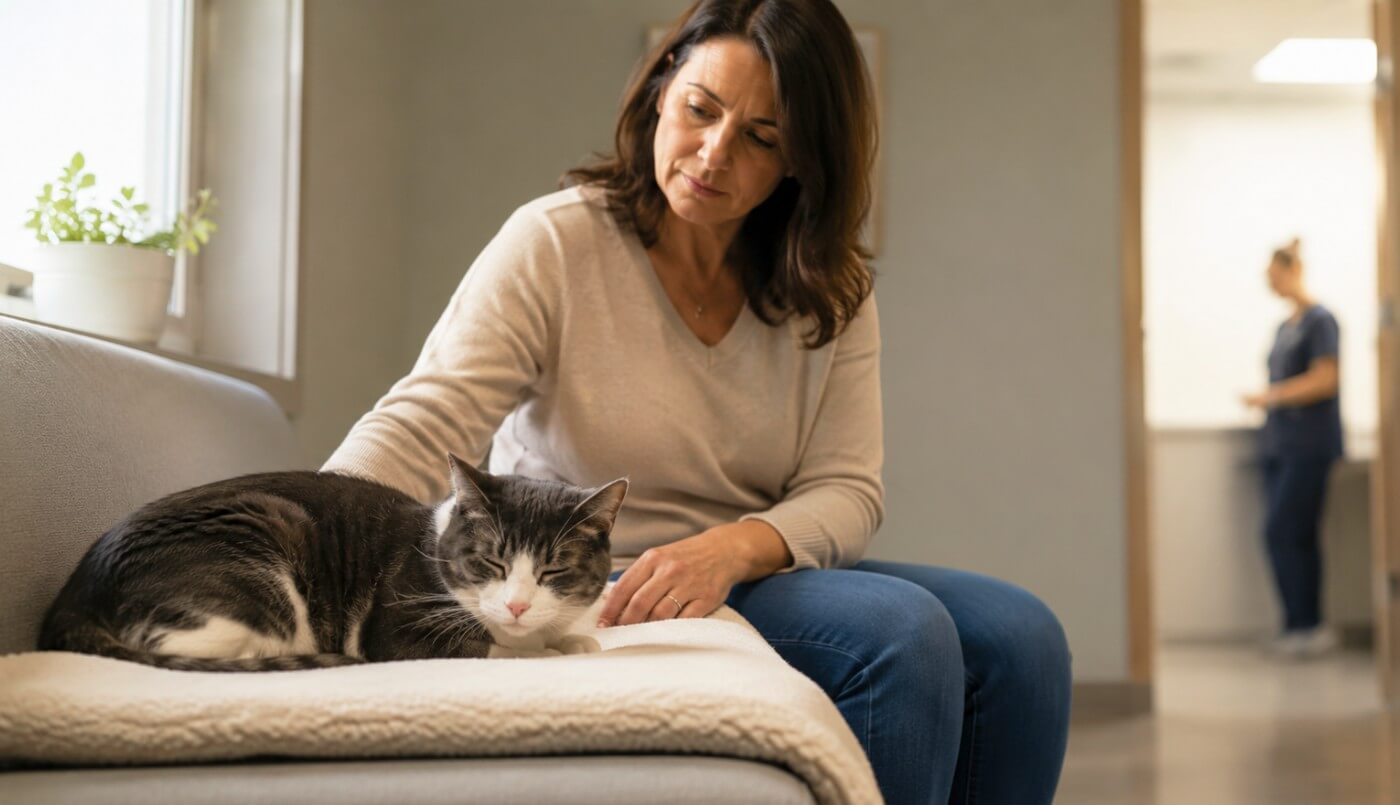
What Happens at a Cat Euthanasia Appointment? A Gentle Guide
Knowing what happens at a cat euthanasia appointment doesn’t make the goodbye easy.
But it can make it a little less frightening.
When a cat euthanasia appointment is ahead of you, fear can fill in every blank.
You might picture something cold or rushed, even if your vet is kind.
You might worry your cat will be frightened, or that you won’t know what to do when the moment comes.
And because most people have never been talked through this before, even the practical details can feel overwhelming: whether you can stay, whether you can hold your cat, what happens afterward, and how you’re supposed to walk out of the clinic without them.
Most people don’t know how a euthanasia appointment works until they’re already living through one.
This article is here to walk you through it gently.
Every veterinary clinic does things a little differently, and your cat’s health, temperament, and condition on the day can affect the details.
But in most cases, the appointment is designed to be calm, quiet, and kind.
Your vet’s goal is not just to help your cat pass peacefully, but to help you get through one of the hardest moments of loving them.
This isn’t a substitute for your own vet’s advice.
If your cat has an appointment booked, it’s always okay to call the clinic and ask exactly what their process will be.
But if you’re trying to prepare your heart, here’s what usually happens.
The short answer
At a cat euthanasia appointment, your vet will usually talk you through the process, ask you to sign a consent form, and confirm your aftercare choices, such as cremation or burial. Your cat may be given a sedative first so they can relax or fall asleep. The vet then gives a euthanasia injection, usually into a vein, which allows your cat to lose consciousness very quickly and pass away peacefully. Afterward, the vet will confirm that your cat has died, and you’ll usually be offered time alone with them if you want it.
That’s the practical version.
The emotional version is this: you’re allowed to be scared, you’re allowed to ask questions, and you don’t have to pretend to be brave on this awful day.
Before the appointment, the clinic may ask about practical choices
Some clinics will ask about aftercare when you book the appointment.
Others will talk you through it when you arrive.
This can feel horribly matter-of-fact, but it isn’t because they don’t care.
It’s because there are decisions that need to be made, and many people find it easier to make them before the final goodbye rather than afterward.
Common questions include:
- Whether you want to stay with your cat during the appointment
- Whether you want your cat cremated
- Whether you want your cat’s ashes returned to you
- Whether you want to take your cat home for burial, if that’s legal and practical where you live
- Whether you’d like a paw print, fur clipping, or other keepsake, and
- Whether you’d prefer to pay before the appointment.
You don’t have to know all of this instantly.
It’s okay to ask the receptionist or vet nurse to slow down and explain your options.
If you already know you’ll struggle to speak on the day, you can write your choices down beforehand or ask someone you trust to come with you.
You may be taken to a quiet room
When you arrive, many clinics will take you to a quieter room rather than having you wait in the main reception area.
Some clinics have a comfort room for end-of-life appointments.
Others may use a normal consult room but give you privacy and extra time.
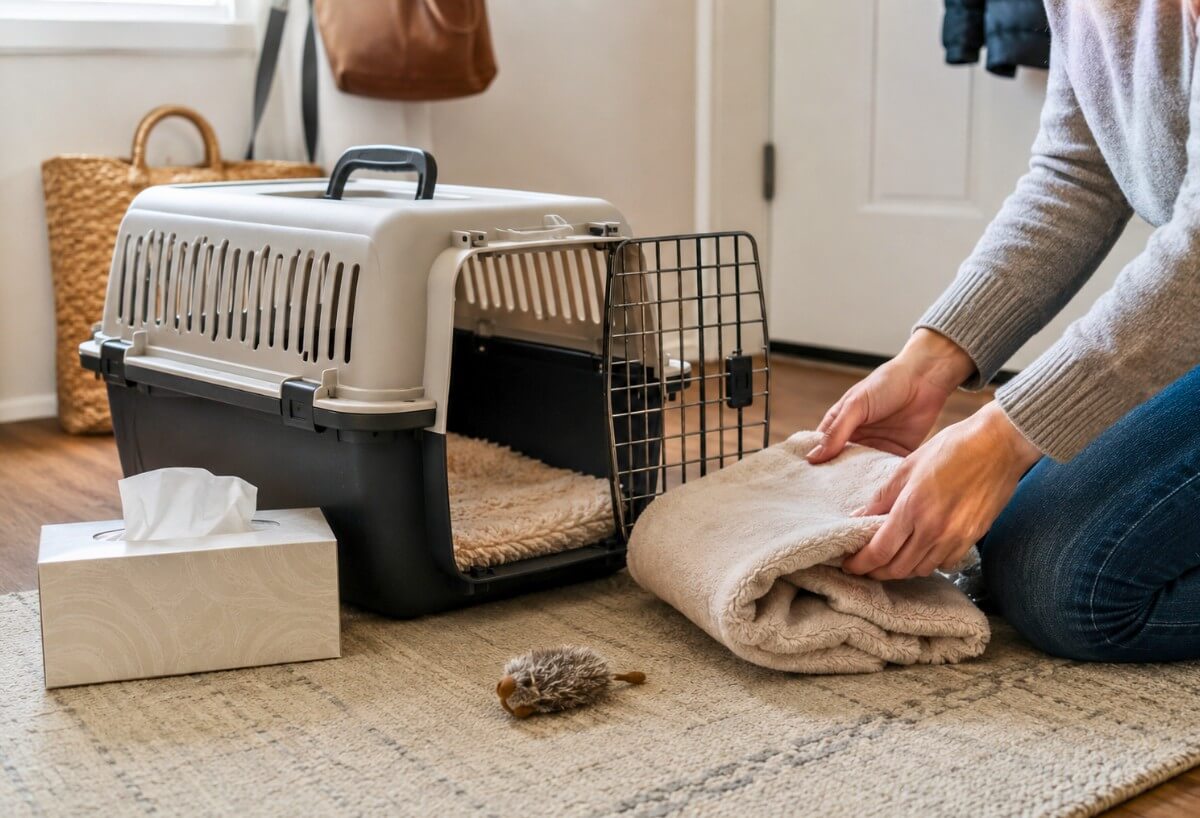
You may be invited to bring your cat’s own blanket, bed, towel, or familiar item.
This can help the appointment feel less stark, and it gives your cat a familiar smell and texture.
Some cats stay in their carrier until the vet is ready.
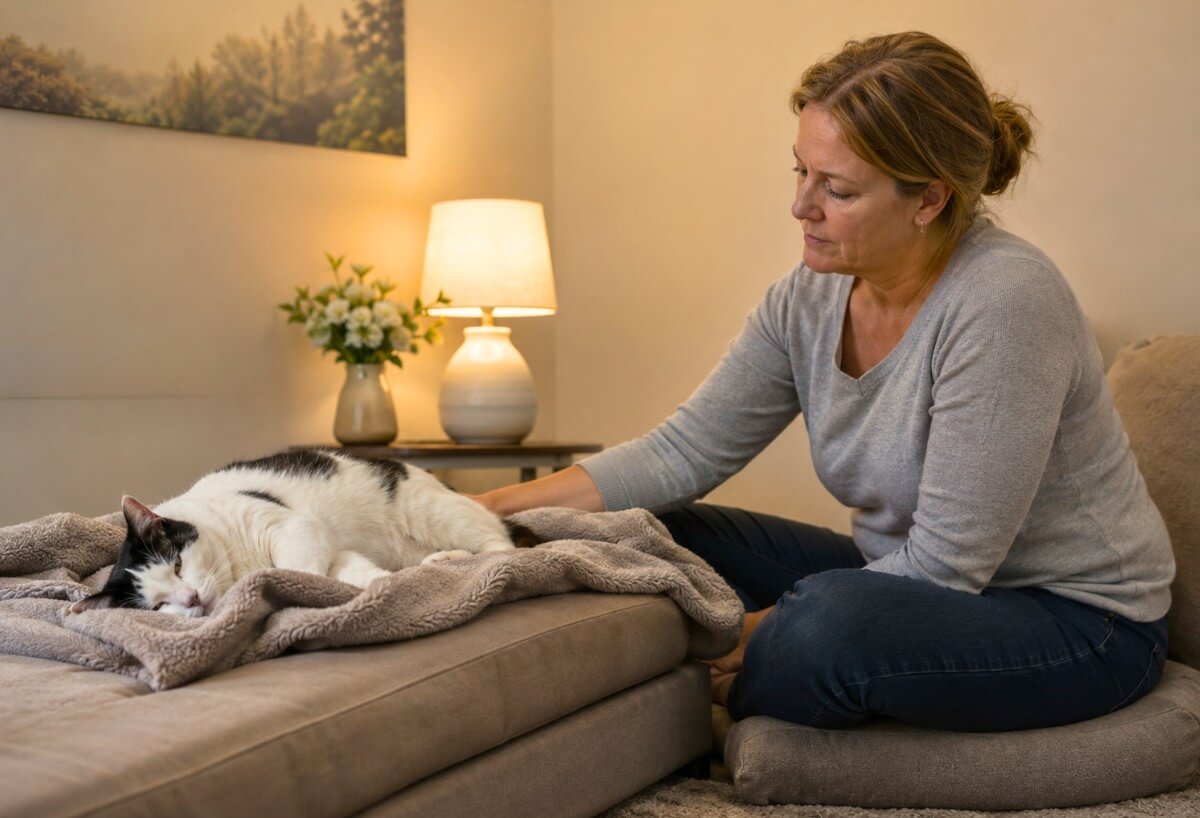
Others settle on a blanket, on your lap, beside you on a couch, or on an exam table with soft bedding.
There’s no perfect setup.
There’s only what feels safest and kindest for your cat.
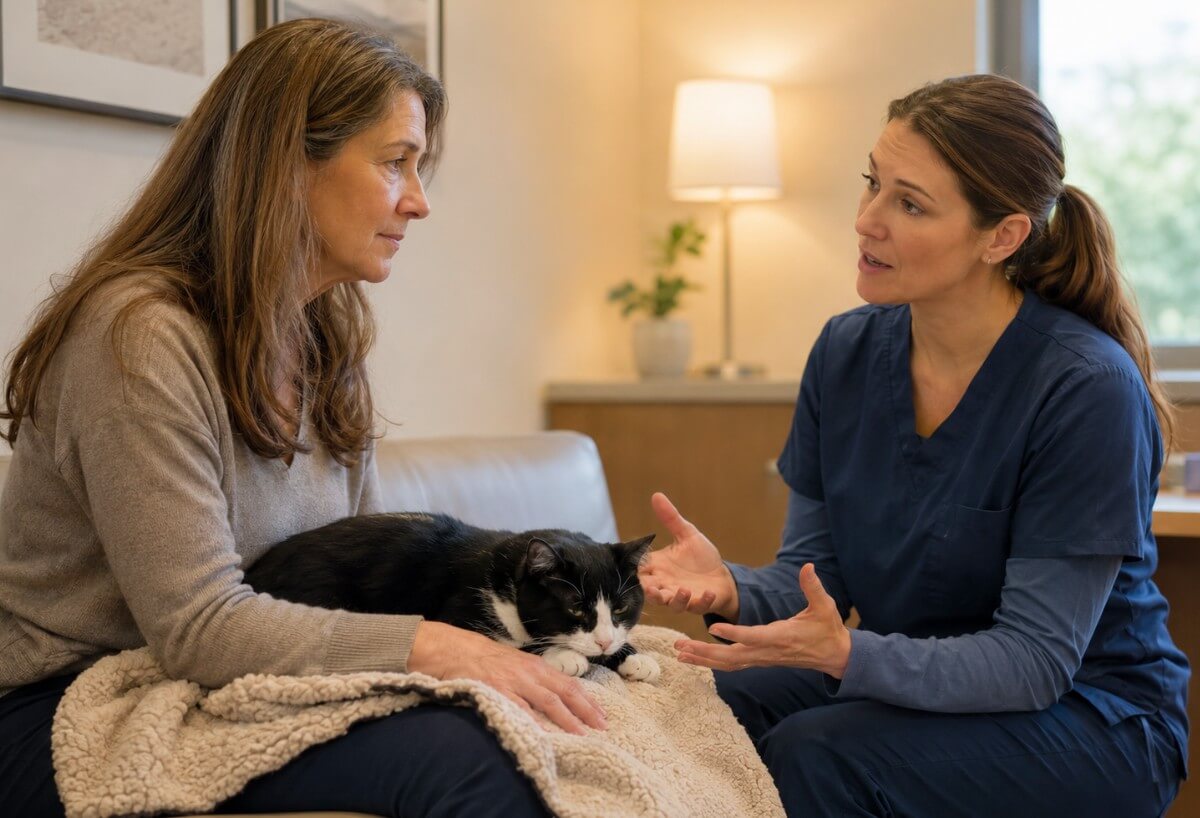
If your cat hates being lifted or handled, tell the vet team.
If your cat is frightened at the clinic, tell them.
If your cat is in pain when moved, tell them that too.
These details matter, and your vet may be able to adjust the process.
The vet will explain what’s going to happen
Before anything begins, the vet will usually explain the steps.
This may include whether your cat will be sedated first, where the final injection will be given, whether a nurse will help, and what you might see afterward.
If the vet doesn’t explain enough, you’re allowed to ask.
You can ask:
- “Will my cat be sedated first?”
- “Can I hold them?”
- “Will they be taken out of the room at any point?”
- “How quickly will it happen?”
- “What might I see after they pass?”
- “Can I have time with them afterward?”
- “Can you tell me before each step?”
These aren’t silly questions.
They’re exactly the kinds of questions many people need answered.
You can also ask the vet not to describe every detail if that feels like too much.
Some people want to know everything.
Others only want the gentlest outline.
Both are okay.
You’ll usually sign a consent form
Before euthanasia, you’ll usually be asked to sign a consent form.
This form gives the vet permission to proceed.
It may also record your aftercare choices, such as cremation or return of ashes.
Signing the form can feel brutal.
Many people say this is one of the hardest parts because it makes the decision feel final.
If your hand shakes, if you cry, if you need a minute, that’s normal.
The vet team has seen this many times.
You’re not being difficult.
You’re saying goodbye to someone you love.
Your cat may be given a sedative first
Many vets give a sedative before the final injection, especially if a cat is anxious, in pain, restless, very frail, or difficult to handle.
The sedative may be given under the skin or into a muscle.
Like many injections, it may sting briefly.
After that, your cat should become more relaxed.
Some cats get sleepy.
Some drift into a deep sleep before the final injection is given.
This waiting period can feel strange because your cat may look peaceful but still be physically present.
You may find yourself stroking them, talking to them, crying into their fur, or just sitting quietly because there are no words left.
You don’t have to fill the silence.
You can tell them they’re loved.
You can say thank you.
You can say nothing and just keep your hand on them.
Your cat doesn’t need a perfect speech from you.
They know your voice, your touch, your smell, and your presence.
The vet may place an IV catheter
In many euthanasia appointments, the vet or nurse may place a small IV catheter into a vein, often in a front leg.
This helps the final injection go smoothly.
A small patch of fur may be clipped.
A nurse may gently hold your cat.
Sometimes the catheter is placed in the room with you.
Sometimes your cat may be taken briefly to another treatment area and brought back.
If you don’t want your cat taken away, ask whether the catheter can be placed in the room.
It may not always be possible, but it’s reasonable to ask.
If your cat’s veins are fragile or circulation is poor, especially when they’re very ill, very old, dehydrated, or close to death, the vet may need to adjust the plan.
This doesn’t mean something has gone wrong.
It means the vet is working with your cat’s body as it is on the day.
The final injection is usually an overdose of anesthetic
The euthanasia injection is usually an overdose of anesthetic medication.
It’s designed to let your cat lose consciousness very quickly and then stop breathing and pass away.
By the time death occurs, your cat should not be aware of what’s happening.
This is the part many people fear most.
In reality, it’s often very quiet and very fast.
Your cat may simply relax, go limp, or seem to fall into a deep sleep.
Their breathing may slow or stop.
The vet will listen to their chest afterward to confirm that their heart has stopped.
Some people feel relief when they see how peaceful it is.
Some feel shocked by how quickly it happens.
Some feel both.
There’s no correct emotional response.
Can you hold your cat during euthanasia?
Sometimes, yes.
Whether you can hold your cat depends on the clinic’s process, your cat’s condition, where the injection is being given, and whether the vet can safely access the vein.
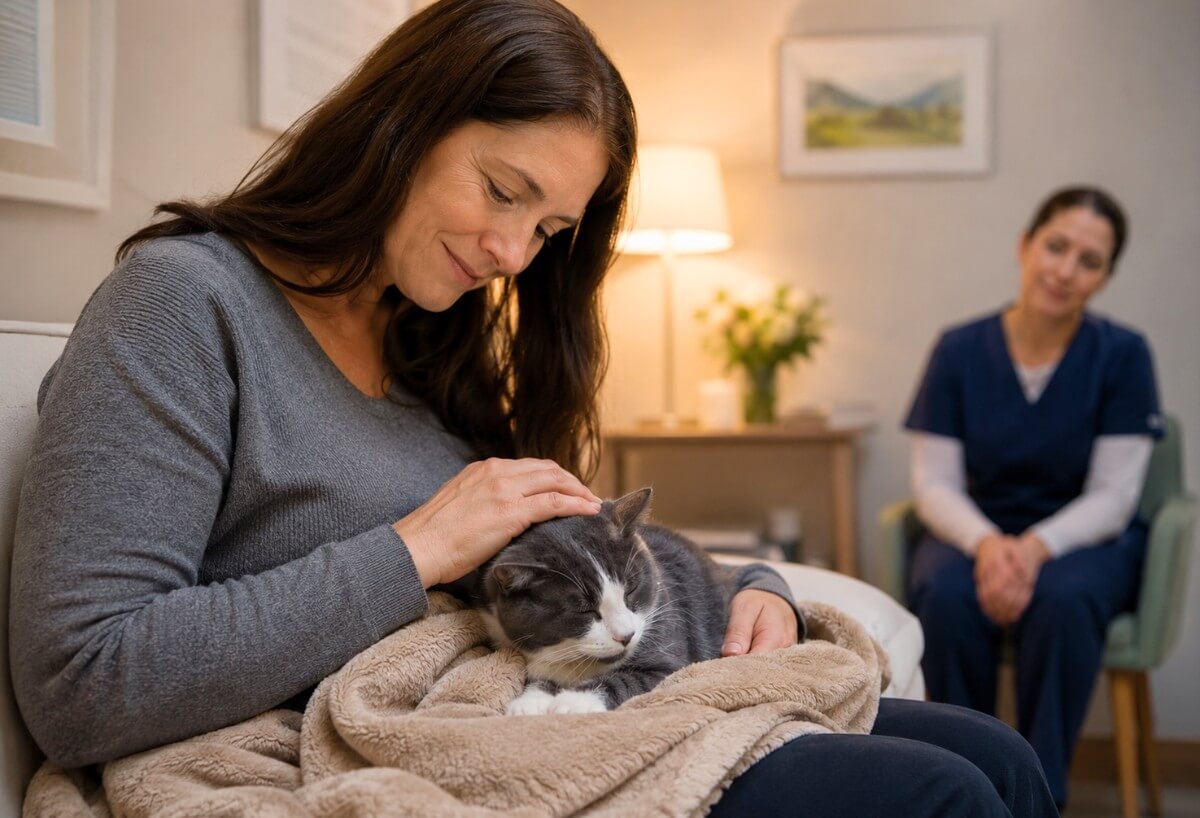
You may be able to hold your cat in your lap, keep your hand on their head, sit beside them, or have them wrapped in a blanket close to you.
If you want to hold them, ask.
If holding them isn’t possible, you can still usually stay close.
You might be able to touch their face, stroke their back, speak softly, or keep your hand near them.
And if you can’t stay in the room, that doesn’t mean you’ve abandoned your cat.
Not everyone can bear to be present for the final injection, and that’s a deeply personal limit. You might say goodbye beforehand, step out for part of the appointment, or stay close the whole way through.
What matters is that your cat was loved and cared for, not that you followed one perfect version of goodbye.
Your love for your cat is not measured by exactly where you stand in the room.
What might happen after your cat passes
After your cat has died, their body may not look the way you expect.
Their eyes may stay open.
Their body may feel softer or heavier.
They may release urine or stool.
You may see small twitches.
You may hear a breath-like sound or a sigh.
These can be natural reflexes after death, not signs that your cat is suffering or trying to come back.
This can be hard to see if you aren’t prepared for it.
But it’s important to know that these movements don’t mean your cat is in pain.
Your vet will confirm that your cat has passed by listening for a heartbeat and checking for breathing.
They may tell you gently, “They’ve gone,” or “They’ve passed.”
That moment can feel unreal.
You may understand the words and still not feel able to absorb them.
You’ll usually be offered time afterward
Most clinics will offer you time alone with your cat after they’ve passed.
You can stay for a few minutes or longer if the clinic is able to allow it.
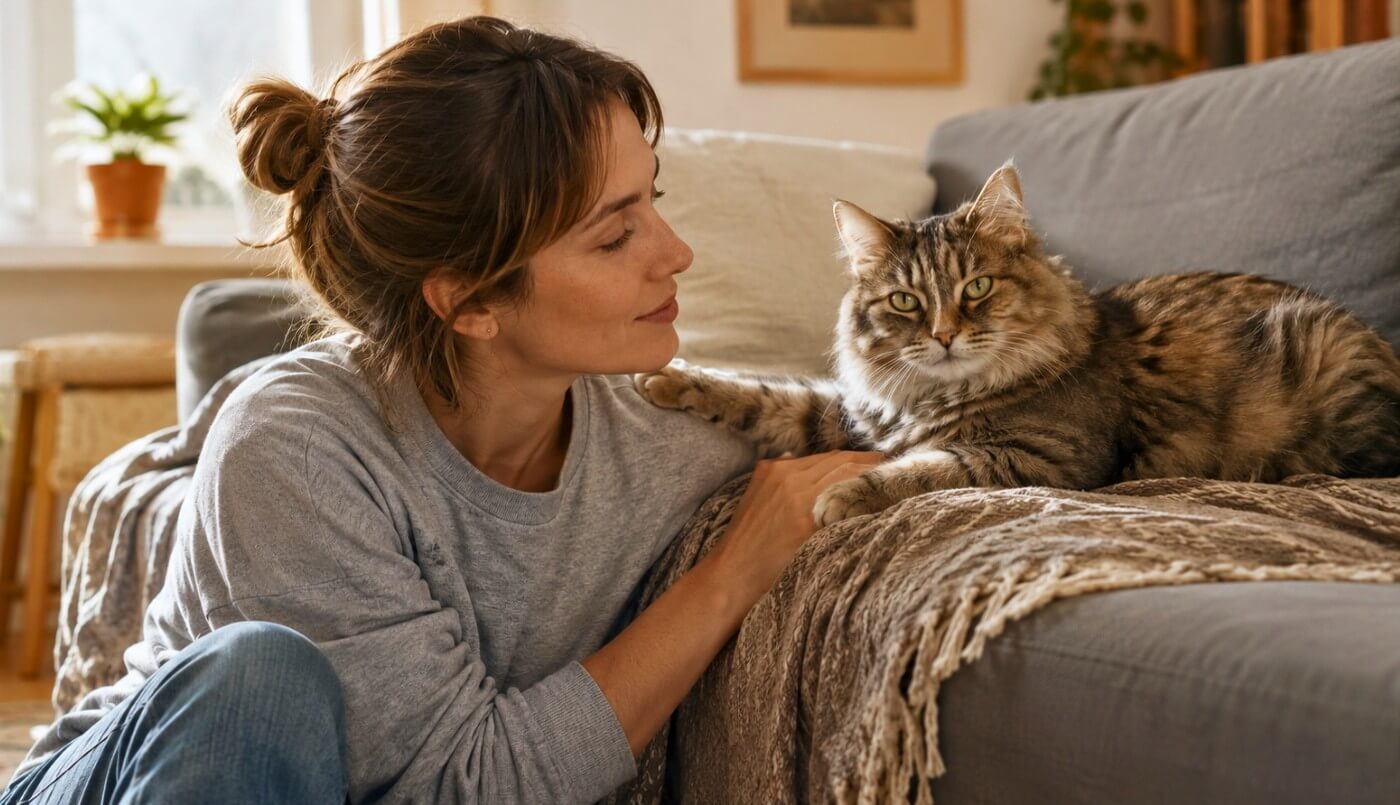
You can touch them, talk to them, kiss their head, tuck their blanket around them, or simply sit there.
Some people want that time.
Others don’t.
If seeing your cat’s body feels too painful, it’s okay to leave.
If you want a little more time, you can ask for it.
And if you find yourself frozen in the room, unsure how to stand up or walk out, you can ask the vet nurse to come back and help you through that moment.
You don’t have to leave gracefully.
You don’t have to say the perfect final words.
You might cry, go quiet, feel numb, or move through the next few minutes as if they aren’t quite real.
However you respond, it doesn’t need to be polished.
It just needs to be survived.
What happens to your cat’s body afterward?
This depends on the aftercare option you choose.
Common options include:
Private or individual cremation: Your cat is cremated individually, and their ashes are returned to you.
Communal cremation: Your cat is cremated with other pets, and ashes usually aren’t returned.
Home burial: This depends on local laws, property rules, and practical considerations.
Your vet can tell you what’s allowed in your area.
Taking your cat home: Some people choose to take their cat home after the appointment, either for burial or for a private goodbye before arranging aftercare.
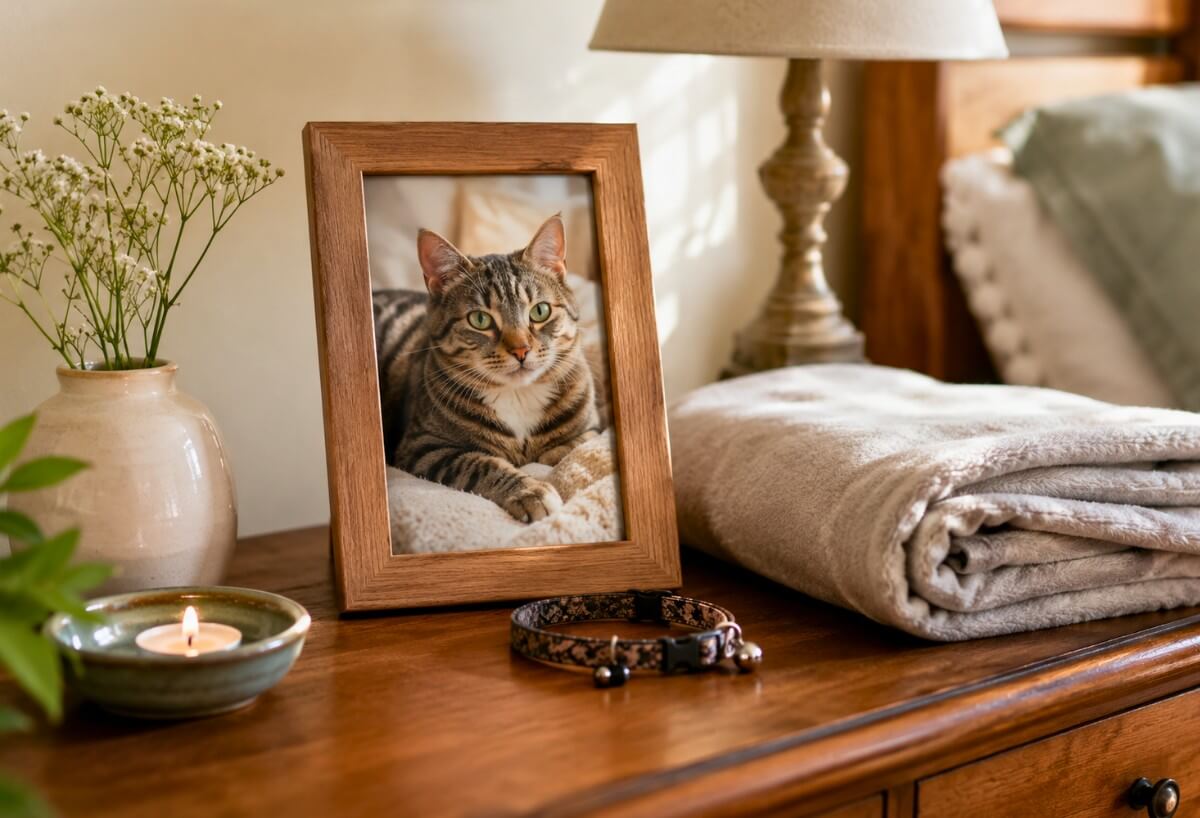
You may also be offered keepsakes such as a paw print, ink print, fur clipping, or memorial item.
It’s okay if you want these things.
It’s also okay if you don’t.
Keepsakes are not proof of love.
They’re just one option for people who find them comforting.
Should children be there?
This depends on the child, the cat, and the family.
Some children cope better when they’re included in an age-appropriate way.
Others may be overwhelmed by being present for the actual appointment.
If children are involved, it’s usually better to use clear, gentle language.
“The vet will help her die peacefully because her body is too sick to get better” is kinder and less confusing than vague phrases like “going to sleep,” especially for young children who may become scared of sleep afterward.
For some families, the kindest option is for children to say goodbye at home rather than attend the appointment itself.
An older child may want to be there, especially if they understand what will happen and have a choice in the matter.
In other cases, it may be better for another adult to care for them while you go, so you can focus on your cat and the goodbye in front of you.
There isn’t one right answer.
The kindest choice is the one that considers both your cat’s peace and your child’s ability to cope.
What if your cat seems calm on the day?
This can be one of the most painful parts.
Your cat may have a better moment just before the appointment.
They may purr.
They may look at you.
They may seem more like themselves for a little while.
That doesn’t automatically mean you’re doing the wrong thing.
Cats can have small pockets of comfort even when their overall condition is poor.
They can purr when they’re content, but also when they’re stressed, sick, or seeking comfort. A single calm moment doesn’t erase the bigger pattern that led you and your vet to this decision.
If you feel shaken, tell your vet.
You can say, “She seems more settled right now, and it’s making me doubt myself.
Can we talk through why we’re here?”
A good vet won’t shame you for needing reassurance.
What if you panic at the appointment?
You might.
Not because you’re weak, but because this is an enormous emotional moment.
Panic can look different from person to person.
You might cry so hard that speaking feels impossible, or you might go completely numb. You might suddenly want to stop everything, even if you know why the appointment is happening.
Sometimes the room, the door, the vet’s voice, and the reality of the moment all seem to arrive at once, and the only thought you can manage is, I can’t do this.
If that happens, say something simple.
“I need a minute.”
“I’m panicking.”
“Can you please talk me through this again?”
“Can we slow down?”
Most vets understand that euthanasia appointments are not ordinary appointments.
They don’t expect you to be composed.
You can also bring someone with you whose job is to listen, ask questions, drive, and help you leave afterward.
Even if you’re usually independent, this is a day when support matters.
What should you bring?
You don’t need much, but a few things can help.
You may want to bring:
- Your cat’s favorite blanket or soft towel
- A familiar bed if it’s easy to carry
- Treats, if your cat still enjoys them
- A carrier that’s comfortable and secure
- Tissues
- Water for yourself
- A support person
- A written note of your aftercare choices, or
- A question list for the vet.
You may also want to plan what happens immediately afterward.
Driving home alone after euthanasia can be very hard.
If someone can drive you, that may help.
If you do go alone, give yourself time before you start the car.
You don’t have to walk out of the clinic and function normally.
Can cat euthanasia be done at home?
In some areas, yes.
At-home euthanasia can be a gentle option for cats who are very stressed by travel, frightened at the vet, or most peaceful in their own familiar space.
The process is usually similar: the vet arrives, talks you through the appointment, gives sedation, waits until your cat is deeply relaxed or asleep, then gives the final injection.
Afterward, they may help with aftercare arrangements.
At-home euthanasia isn’t available everywhere, and it may cost more than a clinic appointment.
It also may not be possible in an emergency or if your cat is in severe distress and needs immediate help.
But if you know your cat’s goodbye is approaching and you think home would be kinder for them, it’s worth asking your vet what options exist.
Is euthanasia painful for cats?
The final euthanasia injection is intended to be painless.
Your cat should lose consciousness very quickly and not be aware of death occurring.
If sedation is given first, that sedative injection may briefly sting, as many injections can.
But the purpose of sedation is to reduce fear, pain, handling stress, and anxiety before the final injection.
If you’re worried your cat will be scared or uncomfortable, ask your vet directly:
“Will she feel anything?”
“Can she be sedated first?”
“How will you make sure she’s calm?”
You’re not being difficult by asking.
You’re advocating for your cat’s comfort.
What if something doesn’t go perfectly?
Most cat euthanasia appointments are peaceful.
But sometimes small things don’t go exactly as expected.
For example, a very sick or elderly cat may have fragile veins or poor circulation, which can make vein access more difficult.
A sedated cat may still make small reflex movements, and after death you might notice a reflex breath, urine release, or eyes that remain open.
These things can be upsetting if you aren’t expecting them, but they’re physical responses, not signs that your cat is suffering.
If something happens that frightens you, ask the vet to explain it.
Sometimes a calm explanation in the moment can prevent that image from becoming something your mind replays with unnecessary guilt later.
The hardest part may be leaving
Many people expect the hardest part to be the injection.
Sometimes it is.
But for others, the hardest part is leaving the room afterward.
Walking out without your cat can feel impossible.
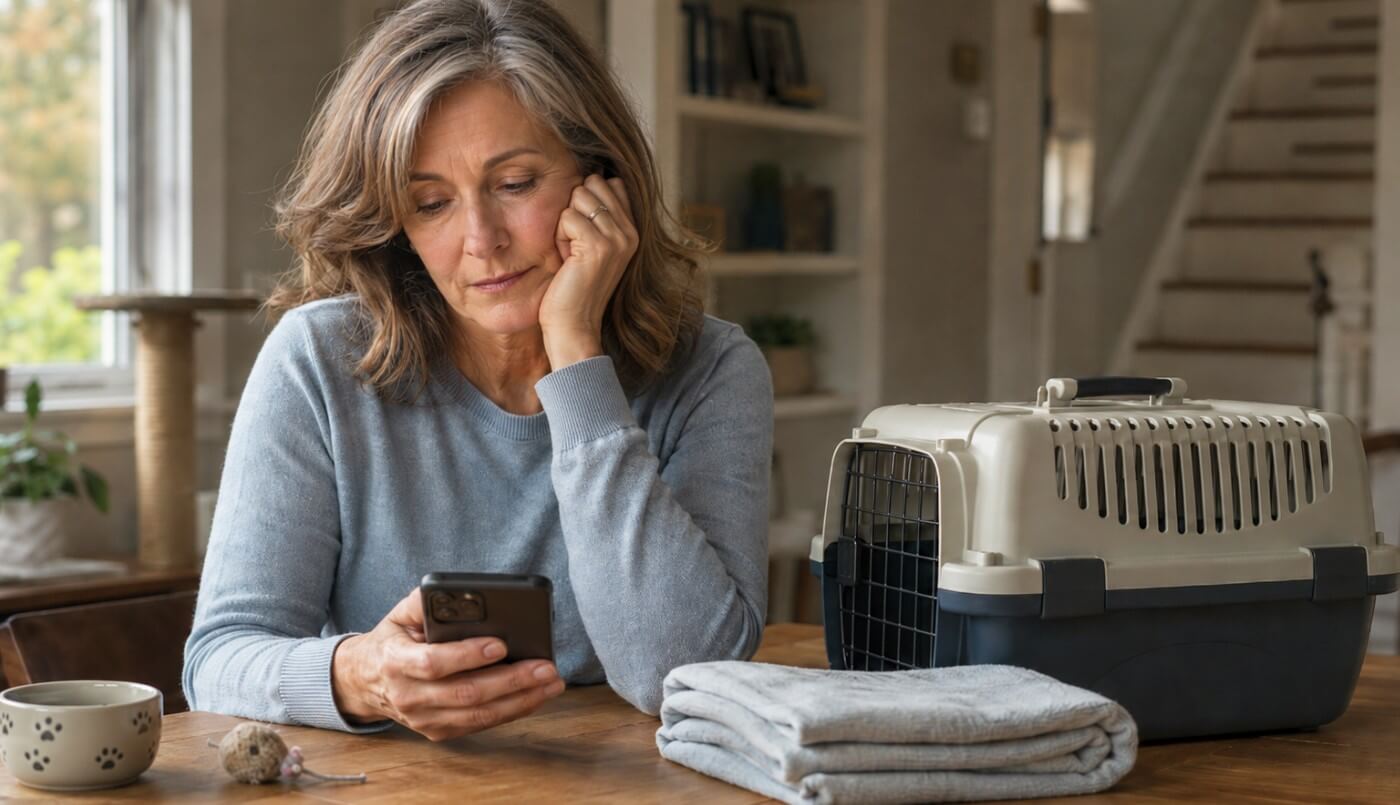
The carrier may feel unbearable.
The car may feel too quiet.
Home may feel wrong before you even open the door.
If you can, make the next few hours gentle.
This probably isn’t the time for errands, messages, or trying to sort out your cat’s things straight away.
The first hour or two after a euthanasia appointment can be raw, unreal, or strangely numb.
You don’t know how your grief will unfold.
Give yourself permission to get home, breathe, and not make any big decisions immediately.
You’ve just said goodbye to a beloved companion.
You’ll be in shock and pain.
You’re allowed to ask for the kind of goodbye you need
Many people don’t realize how much they’re allowed to ask during a euthanasia appointment.
You might want more time, sedation before the final injection, dimmer lights, or for your cat to stay on their own blanket if that’s possible.
You can also ask the vet to explain each step, explain less if the details feel too much, tell you when your cat has passed, or help with keepsakes such as a paw print or a lock of fur.
Not every request will be possible, especially in an emergency, but it’s still okay to ask.
Small adjustments can make a heartbreaking goodbye feel a little more personal, gentle, and bearable.
You don’t have to be calm for your cat to feel loved
A lot of people worry they’ll upset their cat by crying.
It’s understandable.
You want their last moments to be peaceful, and you don’t want your grief to spill over onto them.
But you don’t have to become emotionless to give your cat a loving goodbye.
Crying doesn’t stop you from being gentle.
Even if your hands are shaking or your voice breaks, you can still offer your cat the comfort of your presence.
The vet team can handle the practical parts while you stay close in whatever way you’re able, whether that’s stroking your cat’s head, whispering to them, or simply resting your hand nearby.
Your cat has known you through ordinary days, tired days, messy days, loving days, and hard days.
They don’t need you to become someone else at the end.
They need kindness, comfort, and relief from suffering.
If you’re there with love, that matters.
After the appointment, grief can arrive in strange ways
Grief after the appointment can arrive in unpredictable ways.
It might come as immediate tears, numbness, nausea, relief, guilt, or a strange mix of all of them.
Many people also find themselves replaying the appointment afterward, searching the details for proof that they did the right thing or fearing they somehow got it wrong.
That’s a common part of grief after euthanasia.
Your mind may look for a way to undo the ending.
It may ask whether you waited too long, acted too soon, missed a sign, chose the wrong aftercare, cried too much, didn’t cry enough, stayed too long, or left too quickly.
Try to remember this: euthanasia is not a normal decision made in a normal emotional state. It’s a mercy decision made under heartbreak.
You made it because your cat’s life and comfort mattered to you.
That doesn’t make it easy.
But it does mean the decision came from love.

Final thoughts
A cat euthanasia appointment may be one of the hardest goodbyes you ever face.
But it’s not meant to be cruel, frightening, or rushed.
It’s meant to help your cat pass as peacefully as possible, with dignity, comfort, and care.
Ask questions.
Bring the blanket.
Say the words you need to say.
Stay if you want to stay.
Step out if you need to step out.
Let the vet team help you.
And afterward, be gentle with yourself.
You didn’t fail your cat because their life came to an end.
You loved them all the way to the place where love had to become letting go.
Frequently Asked Questions
What happens during a cat euthanasia appointment?
At a cat euthanasia appointment, the vet will usually explain the process, ask you to sign a consent form, and confirm your aftercare choices. Y
our cat may be sedated first so they can relax or fall asleep.
The vet then gives a euthanasia injection, usually into a vein, which allows your cat to lose consciousness quickly and pass away peacefully.
Can I stay with my cat during euthanasia?
In most cases, you can choose whether to stay with your cat during euthanasia.
Some people stay for the whole appointment, some say goodbye before the final injection, and some return afterward.
Your choice doesn’t measure how much you love your cat.
If you’re unsure, ask your vet what options are possible.
Is cat euthanasia painful?
The final euthanasia injection is designed to be painless.
Your cat should lose consciousness very quickly and not be aware of death occurring.
If your cat is anxious, painful, or difficult to handle, your vet may give a sedative first to help them relax.
Will my cat’s eyes close after euthanasia?
A cat’s eyes often stay open after euthanasia.
This can be upsetting if you aren’t expecting it, but it’s normal and doesn’t mean your cat was awake or suffering.
Their body may also make small reflex movements or release urine after death.
Can I hold my cat while they’re being put to sleep?
Sometimes you can hold your cat, but it depends on your cat’s condition, the clinic’s process, and where the vet needs to give the injection.
If holding your cat matters to you, ask the vet.
Even if you can’t hold them fully, you may still be able to stay close, touch them, and talk to them.
What should I bring to my cat’s euthanasia appointment?
You may want to bring your cat’s favorite blanket, a soft towel, treats if they still enjoy them, tissues, water for yourself, and a support person.
It can also help to bring a written note of your aftercare choices so you don’t have to make every decision while overwhelmed.
What happens to my cat after euthanasia?
After euthanasia, you can usually choose cremation, return of ashes, home burial where allowed, or another aftercare option offered by your vet.
Some clinics can also arrange paw prints, fur clippings, or other keepsakes if you want them.
Facing a euthanasia appointment can feel frightening, especially when you don’t know exactly what will happen. I hope this article has made the process feel a little less overwhelming and helped you think about the kind of goodbye you and your cat may need.
Was there something your vet did that brought you comfort, or something you wish you’d known beforehand? Please share only what feels right. Your experience may gently help another cat parent preparing for this heartbreaking day.