
Anticipatory Grief for a Cat: How to Cope Before Goodbye
There’s a strange kind of grief that can arrive while your cat is still here.
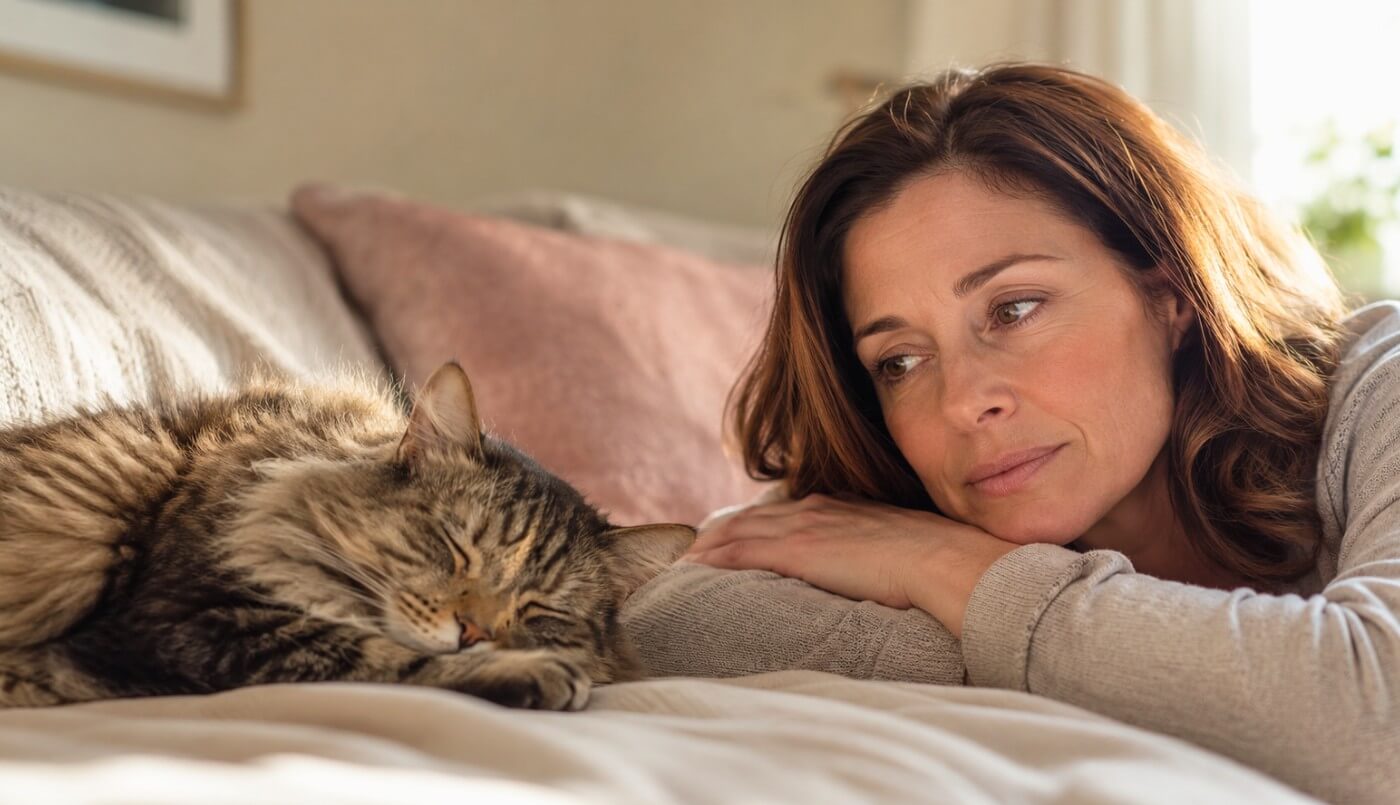
Your cat may still be eating, sleeping, purring, stretching in the sun, or asking for attention in the same familiar ways.
They may still be sleeping beside you on the sofa.
They may still look up when you say their name.
And yet, part of you is already missing them.
You might look at their bed and imagine it empty.
You might hear them breathing and feel panic instead of comfort.
You might find yourself crying while they’re still curled up beside you, then feel guilty because they’re alive and you “should” be grateful for the time you still have.
This is anticipatory grief.
It’s the grief that begins before the loss has fully happened.
It often appears when a cat is very old, seriously ill, declining, or living with a diagnosis that has changed the way you see the future.
And it can feel awful.
Not just sad, but confusing.
You’re grieving someone who’s still physically present.
You’re trying to love them in the moment while your mind keeps running ahead to the day they won’t be there.
That doesn’t mean you’re doing anything wrong.
It means you’re living in one of the hardest emotional places a cat parent can live: the space between still here and someday gone.
The short answer
Anticipatory grief for a cat is the grief you feel before your cat has died. It often happens when your cat is seriously ill, very old, declining, or approaching the end of life. You may feel sad, anxious, guilty, numb, or already heartbroken while your cat is still physically here.
That doesn’t mean you’re giving up on them. It means you love them, you understand that time may be limited, and your heart is already responding to the loss you know may be coming.
Yes, anticipatory grief is normal
If you’re already grieving your cat before they’ve died, you’re not cold, dramatic, ungrateful, or broken.
You’re responding to a real loss that has already begun.
That may sound strange, because your cat is still alive.
But serious illness, old age, and decline can change daily life long before the final goodbye. You may already be losing pieces of the life you knew together.
Your daily life may already look different.
Your cat might not jump onto the bed anymore, greet you at the door as often, or move through the house with the same ease.
You may be managing medication, special food, grooming help, vet updates, or the constant low-level worry of leaving them alone for too long.
You may still have your cat, but you may already be missing the life you had before the diagnosis, before the decline, before every small change started to feel loaded with meaning.
That’s why anticipatory grief can be so heavy.
It’s not only grief for the future.
It’s grief for the changes that are already happening now.
What anticipatory grief can feel like
Anticipatory grief doesn’t always look like constant crying.
Sometimes it does, but often it shows up in less obvious ways.
This kind of grief can show up as anxiety over small changes: a skipped meal, a quieter day, a new sleeping spot, a different sound in their breathing.
You may find yourself checking on your cat more often than you mean to, searching online late at night, or feeling unusually irritated by ordinary things because your emotional energy is already stretched thin.
Sometimes it doesn’t feel like panic at all.
It feels like numbness, which can be just as unsettling.
That can be frightening, especially if you adore your cat.
But numbness is not proof that you don’t care.
Sometimes it’s your mind’s way of giving you a little distance from something too painful to hold all at once.
Other signs of this can include guilt, dread, trouble sleeping, difficulty concentrating, feeling detached from people who don’t understand, or suddenly crying over small domestic details: a food bowl, a favorite blanket, a patch of sun where your cat likes to sleep.
One of the most painful parts is that you may feel as though you’re grieving in secret.
From the outside, your cat is still here.
Other people may not understand why you’re already struggling.
But your heart understands that something has changed.

It doesn’t mean you’ve given up on your cat
One of the cruelest thoughts anticipatory grief can bring is this one:
“Am I already acting like they’re gone?”
That thought can make you feel ashamed of your own sadness.
You may worry that grieving now means you’ve stopped fighting for your cat, stopped believing in them, or started emotionally abandoning them before the end.
It doesn’t mean that.
Grieving before your cat dies doesn’t mean you’ve given up.
It means you understand that love and loss are now sitting very close together.
You can still book the vet appointment, give the medication, warm the food, clean the blanket, stroke their head, and notice when they’re having a good day.
You can still hope for comfort, more time, better appetite, a peaceful week, or another ordinary morning together.
And you can still grieve.
Those things can exist at the same time.
In fact, they often do.
You’re not choosing sadness over love.
The sadness is there because of the love.
The guilt of grieving while your cat is still alive
Anticipatory grief often comes with guilt because the timing feels wrong.
You may think, “They’re still here. I should be enjoying every second.”
But no one can live in a state of perfect gratitude all day, especially while caring for a sick or elderly cat.
You’re not a machine.
You’re a person under emotional strain.
You may also feel guilty for crying near your cat.
Many people worry their cat will sense their sadness and become distressed.
Cats are sensitive, but they don’t need you to perform constant cheerfulness.
They need your steadiness, your care, and your familiar presence.
Sometimes that presence includes tears.
That’s not a failure.
If you’re very upset, it can help to take a few minutes in another room, breathe, drink some water, and come back gently.
Not because your sadness is dangerous, but because you deserve a little space to soften the edge of it.
Your cat doesn’t need you to be a saint.
They need you to keep loving them in the real, human way you’re able to love them today.
When love turns into constant monitoring
One of the hardest parts of caring for a sick cat is that love can start to look like surveillance.
You may find yourself noticing everything now: how much they eat, how easily they move, whether the litter box looks normal, whether their breathing sounds different, whether today feels better or worse than yesterday.
Some of that attention is part of caring for a sick cat, but it’s exhausting when every small detail starts to feel like something you have to decode.
Some monitoring is necessary.
It helps you make good decisions and notice changes that matter.
But constant monitoring can also make it hard to see your cat as your cat.
Instead of seeing the beloved creature who has shared your life, you may start seeing symptoms, signs, clues, and possible endings.
Every nap becomes a question.
Every skipped meal becomes a warning.
Every quiet hour becomes something to interpret.
That’s exhausting.
A small practical boundary can help.
You might keep a simple note of food, medication, litter box changes, and anything you want to ask the vet, then give yourself permission to stop mentally tracking for a while.
Not forever.
Just for a little pocket of time.
During that pocket, your only job is to be near your cat.
Not to solve the whole future.
Not to decide everything tonight.
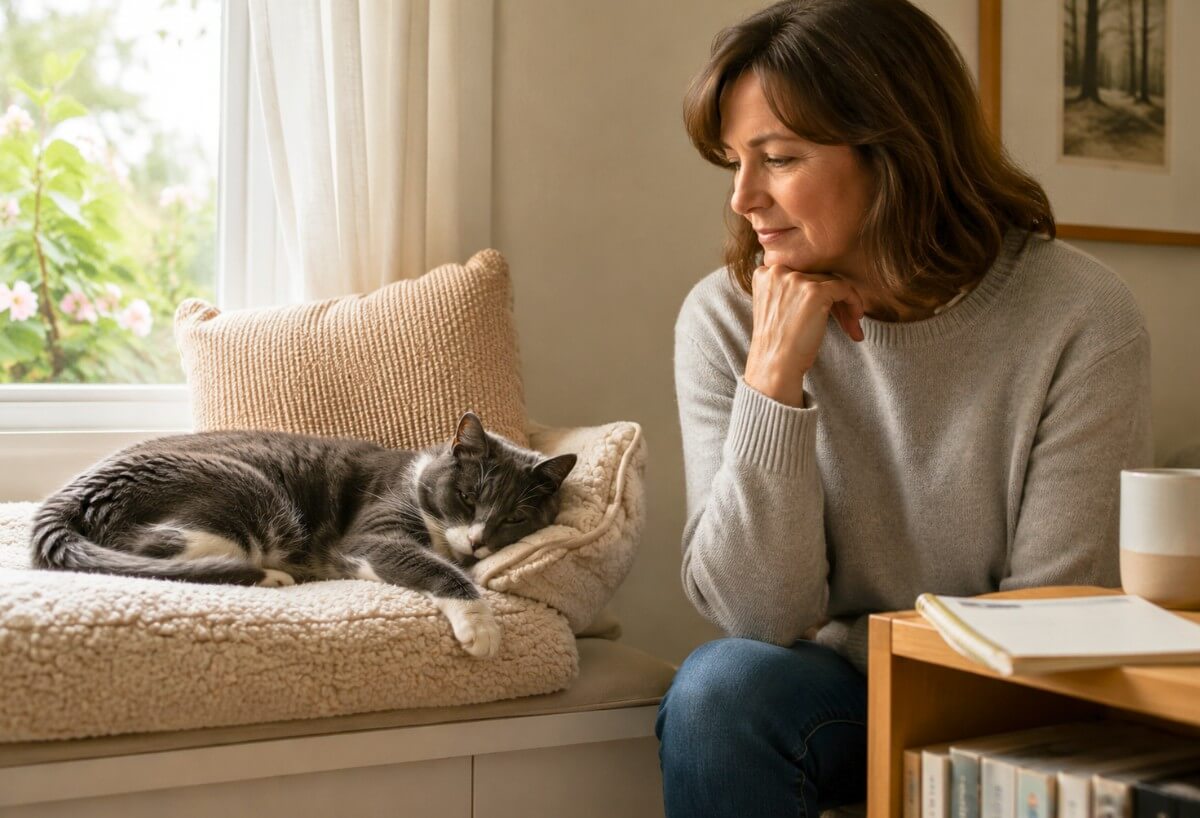
Just to notice them as they are in this moment: warm, breathing, familiar, still here.
Being present doesn’t mean feeling peaceful
People often talk about “being present” as if it means becoming calm and enlightened.
That can feel almost insulting when your cat is sick.
You may be sitting beside them while your mind is full of vet bills, test results, medication schedules, quality-of-life questions, and the unbearable thought of the house without them. You may be stroking their fur while silently panicking.
That still counts as being present.
Presence doesn’t mean you’re peaceful.
It means you’re here.
It means you’re not running away from the reality.
Some days, being present may look like lying beside your cat for ten minutes without checking your phone.
Some days it may mean noticing one ordinary thing: the weight of their body, the shape of their paws, the sound of their purr, the way they lean into your hand.
You don’t have to turn every moment into a memory.
That’s too much pressure.
Some moments can just be moments.
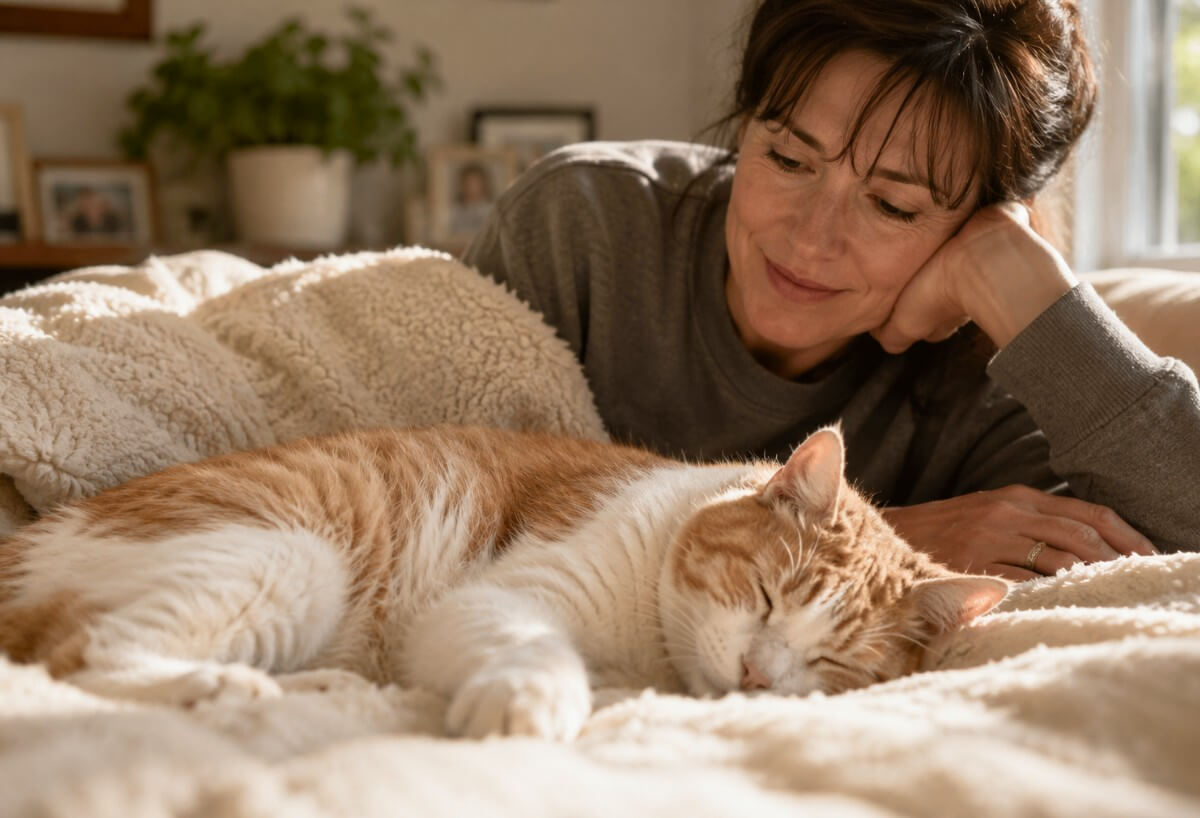
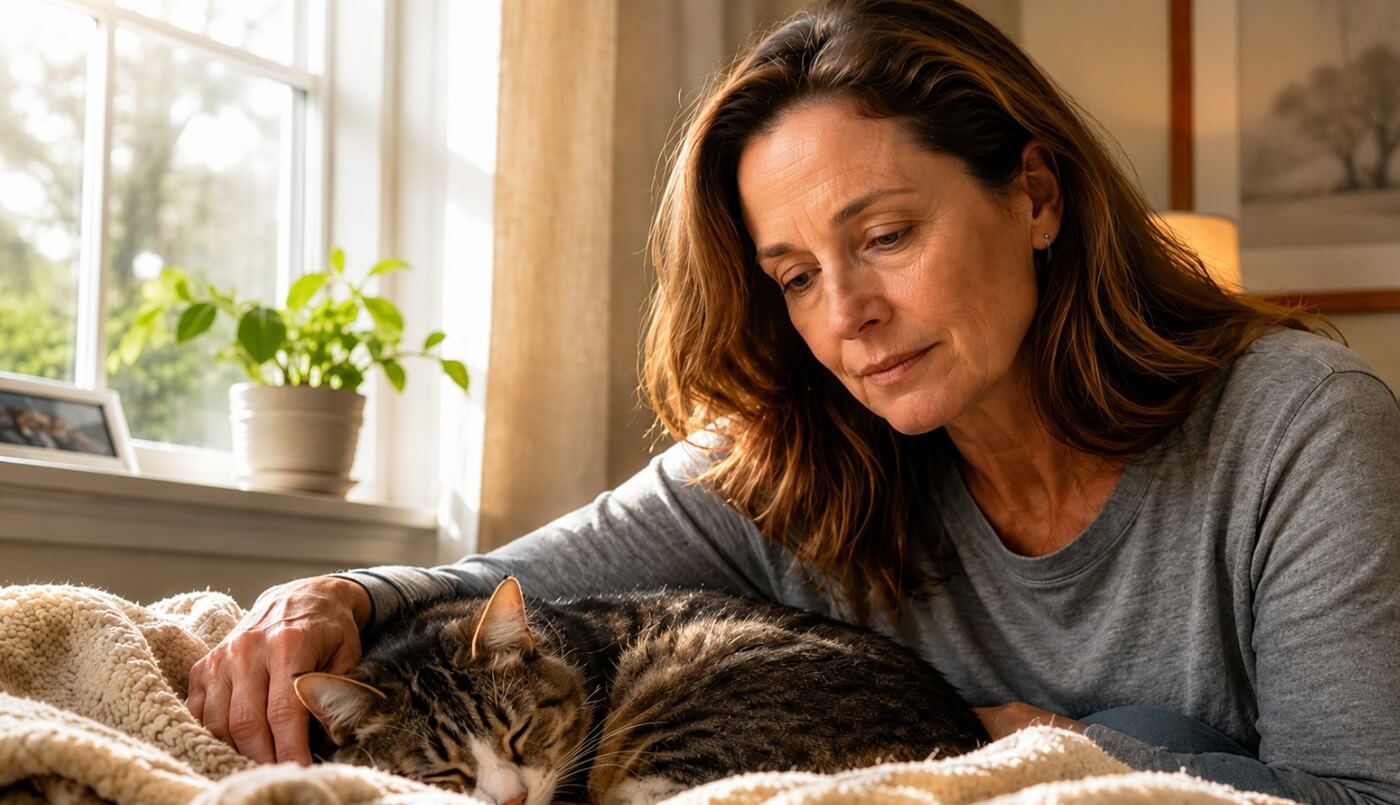
A cat sleeping in a warm room.
A hand resting nearby.
A quiet afternoon that doesn’t need to become profound in order to matter.
Preparing for goodbye without living in goodbye
There’s a difference between preparing and rehearsing the loss over and over.
Preparing can be kind.
It can reduce panic later.
It can help you make choices with more clarity when emotions are high.
Rehearsing is different.
Rehearsing is when your mind keeps dragging you through the worst moment again and again, as if imagining it enough times will somehow protect you from it.
It won’t.
If there are practical things you need to think about, try to handle them in small, contained ways.
You might ask your vet what changes to watch for.
You might talk through comfort care, pain control, emergency options, or what to expect if euthanasia becomes the kindest choice.
You might think about aftercare, a keepsake, or how you’d like your cat’s final hours to feel if you have any control over that.
These are painful things to consider, but they’re not betrayals.
Quiet preparation doesn’t mean you’re inviting death to come closer.
It means you’re trying to protect your cat, and yourself, from chaos if the time comes.
Then, when the practical thing is done, come back to today.
Today your cat may want food, a warm blanket, a sunny window, a soft voice, or simply your company.
That’s still real.
You’re allowed to have complicated feelings
Anticipatory grief is rarely one clean emotion.
You may feel love, dread, tenderness, frustration, guilt, gratitude, resentment, hope, helplessness, and exhaustion, sometimes in the same hour.
That can be especially hard if caregiving has become intense.
You might love your cat completely and still feel worn down by medication times, interrupted sleep, cleaning, appointments, costs, and the constant emotional weight of decision-making.
Having moments of exhaustion doesn’t mean you want your cat gone.
It means caregiving is hard.
Many cat parents feel ashamed to admit that part.
They think love should make everything feel willingly bearable.
But love doesn’t remove the strain.
It often increases it, because every task matters so much.
You can love your cat completely and still feel tired, overwhelmed, and frightened by what comes next.
More time can be precious and demanding at the same time, especially when every day carries so much care and uncertainty.
There’s nothing wrong with you for having a human response to an impossible situation.
Try not to spend all your remaining time in the internet rabbit hole
When you’re frightened, searching can feel like action.
Sometimes research is useful.
It can help you understand a diagnosis, prepare questions for your vet, or learn what supportive care might be available.
But the internet can also become a fear machine, especially late at night.
Forums, worst-case stories, old posts, miracle claims, and conflicting advice can leave you more panicked than informed.
One search becomes twenty.
One symptom becomes a list of terrifying possibilities.
One stranger’s experience starts to feel like a prediction.
If you notice that researching is making you spiral, it may help to write down the actual question and save it for your vet instead of trying to solve it through more searching.
You don’t need the entire internet tonight.
You need the next kind step.
That might be offering food.
It might be sending a message to the clinic.
It might be sitting with your cat.
It might be going to bed because you’ll care for them better tomorrow if you’ve had some rest.
Make room for ordinary love
When you know time may be limited, ordinary moments can start to feel unbearably precious.
That can be beautiful, but it can also create pressure.
You may feel you should be fully appreciating every second, taking photos, making memories, saying all the right things, and never wasting a moment.
But real love is not always cinematic.
At this stage, love often becomes quiet and practical.
You warm food, change litter, adjust blankets, clean up small messes, and let your cat rest even when you wish you could hold them.
Some of the most loving moments are the ones where you simply stay close and let the moment be ordinary.
Your cat doesn’t need every day to be extraordinary.
Cats are creatures of ordinary comfort.
A safe room, a familiar smell, a favorite sleeping spot, a gentle voice, the person they know.
You may look back one day and realize those ordinary moments were not small at all.
Talk to someone who won’t minimize it
Anticipatory grief can feel lonelier when people around you don’t understand pet loss.
Someone may say, “But your cat is still alive.”
They may mean well, but it can make you feel foolish for hurting.
You’re not foolish.
It can help to talk to someone who understands that loving a cat is not a casual attachment. That might be a friend who has been through pet loss, a pet grief support group, a compassionate vet team, a counselor, or even one person who can listen without trying to fix it.
You don’t need someone to make the situation okay.
It isn’t okay.
You need someone who can sit with the truth of it and not make you defend why your cat matters this much.
When to ask for extra support
Anticipatory grief is normal, but that doesn’t mean you have to carry it alone.
It’s worth seeking extra support if you’re unable to sleep for long stretches, struggling to eat, having panic that feels unmanageable, feeling unable to function, or feeling completely isolated.
It’s also important to reach out for urgent help if your grief starts making you feel unsafe or as if you might hurt yourself.
Support doesn’t mean your grief is wrong.
It means this is heavy, and you deserve help holding it.
A counselor, therapist, doctor, grief support service, or pet loss support group can give you somewhere to put the fear, guilt, and sadness that may feel too big to keep carrying in silence.
Your cat needs care, but so do you.
Anticipatory grief doesn’t use up your grief
Grieving before the loss can sometimes make certain parts of goodbye feel less chaotic.
You may have time to think through practical decisions, ask questions, take photos, say the things you want to say, and make choices around your cat’s comfort before everything feels urgent.
But anticipatory grief doesn’t use up the grief.
When your cat dies, the loss may still hit with full force.
Or you may feel numb.
Or relieved.
Or shocked, even if you knew it was coming.
You may feel all of those things at different times.
None of that means you did anticipatory grief wrong.
There’s no emotional bargain where suffering in advance guarantees a softer landing later. Pre-loss grief is not a payment.
It’s simply what happens when your heart starts responding to the coming absence before the absence has fully arrived.
So if you’re grieving now, be gentle with yourself.
And if you grieve later too, be gentle then as well.
While your cat is still here
The hardest thing about anticipatory grief is that it asks you to live in two kinds of realities.
Right now, your cat is still here.
But your cat will not be here forever.
Both truths hurt in different ways.
You don’t have to choose one truth and reject the other.
Your cat is still here, and the thought of losing them still hurts.
You may cry, prepare, hope, worry, and keep loving them through the ordinary routines of the day.
Missing your cat before they’re gone doesn’t mean you’ve left them behind.
It means your heart already knows how much they matter.
That’s not a failure.
It’s love trying to survive the knowledge of loss.
And today, for this moment, your cat is still part of your world.
So take the next small step.
Speak softly.
Rest your hand nearby.
Notice one thing you love about them that is still true.
You don’t have to hold the whole future right now.
You only have to be here, with them, as kindly as you can.
Frequently Asked Questions
Is it normal to grieve a cat before they die?
Yes. Grieving before a cat dies is often called anticipatory grief.
It can happen when your cat is seriously ill, elderly, declining, or approaching the end of life.
It doesn’t mean you’re giving up on them.
It means you’re already feeling the emotional weight of a loss you know may be coming.
Why do I keep crying when my cat is still alive?
You may be crying because part of the loss has already begun.
Your routines may have changed, your cat may seem different, or you may be living with uncertainty about how much time is left.
Crying while your cat is still alive doesn’t mean you’re wasting the time you have.
It means you’re human, and this hurts.
Does anticipatory grief mean I’ve accepted my cat is going to die?
Not necessarily.
Anticipatory grief can happen even when you’re still hoping for more time.
You may move back and forth between hope, fear, sadness, denial, and practical planning.
That emotional back-and-forth is common when you’re caring for a sick or elderly cat.
How can I cope with anticipatory grief for my cat?
Try to focus on the next kind step rather than the whole future.
Keep practical notes for your vet, limit panic-searching online, ask for support from someone who understands pet loss, and make room for ordinary moments with your cat.
You don’t have to feel peaceful to be present.
Will grieving before my cat dies make the loss easier afterward?
Not always.
Anticipatory grief may help you prepare emotionally or practically, but it doesn’t prevent grief after the loss.
You may still feel devastated, numb, relieved, shocked, or guilty when your cat dies.
That doesn’t mean you failed to prepare.
It means your cat mattered deeply.


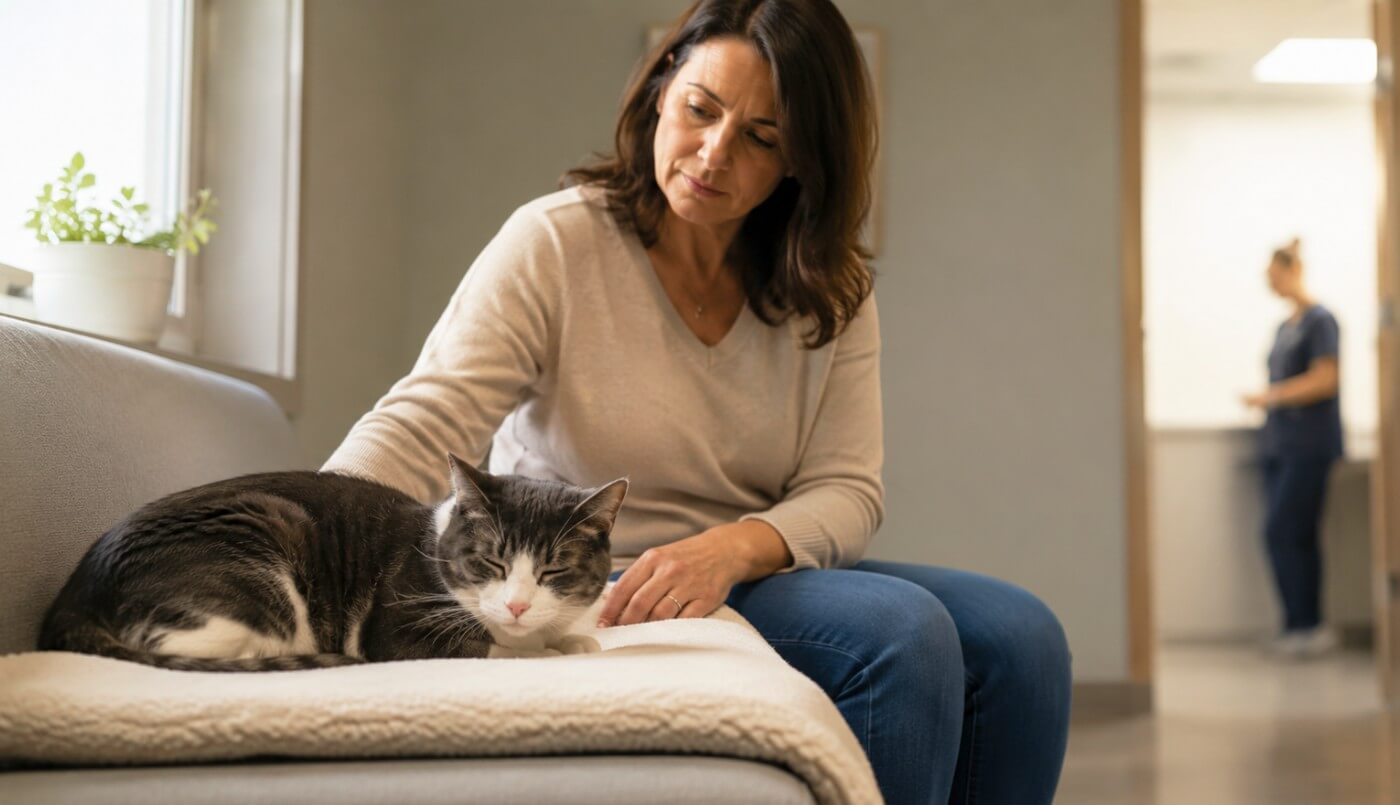
Anticipatory grief can feel incredibly lonely, especially when other people don’t understand why you’re grieving a cat who is still here.
Have you experienced this mixture of love, fear, guilt and sadness while caring for an elderly or unwell cat? You’re welcome to share as much or as little as feels comfortable. Your words may help another cat parent feel less alone.